On this page
Subscribe to receive the latest blog posts to your inbox every week.
By subscribing you agree to with our Privacy Policy.
Welcome to our first HR Journal of 2026! To kick off the year, our HR Specialist, Diellona Maloku, sat down with our Directors of Engineering, Shqiprim Bunjaku and Leutrim Musliu.
We wanted to dig deeper into what makes this team tick, exploring the technical vision for the year ahead and what it means to build world-class software at our company.
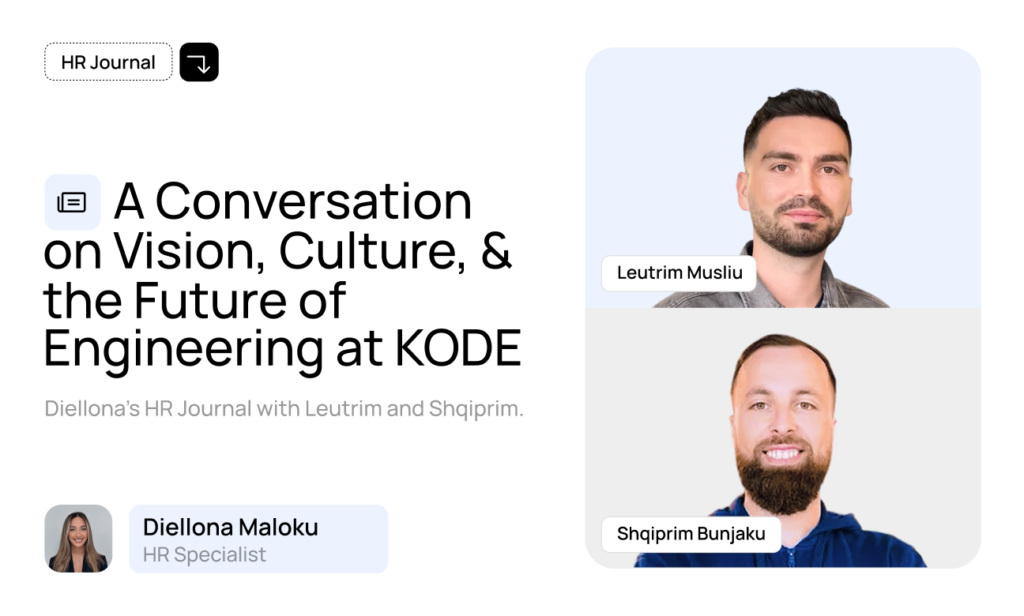
When asked what truly distinguishes our engineering department from the rest of the industry, both directors agreed it comes down to one core concept: ownership.
Leutrim adds that this level of responsibility is only possible because of the environment the leadership team has cultivated. “We balance those strong technical standards with a healthy, respectful team culture,” Leutrim says. He points out that while the standards are high, engineers are trusted to make decisions, take responsibility, and follow projects from start to finish. “Open communication is a core standard for us. Team members are encouraged to share ideas, ask questions, and raise concerns freely, which leads to better decisions and stronger outcomes. We also treat mistakes as learning opportunities rather than failures, creating an environment where engineers can grow confidently.”
For Shqiprim, this goes far beyond simply clearing a backlog. “What truly sets us apart is our end-to-end ownership culture,” he explains. “Our engineers aren’t just working on isolated tickets or narrow components. They own problems from idea to production.” He emphasizes that at KODE, engineers are expected to understand the full context: the business value and the real-world impact of what they build. “Context creates stronger judgment,” Shqiprim notes. “Because people aren’t just implementing tasks, they’re building solutions that matter.”
As we look toward the year ahead, the conversation shifted to our most exciting technical challenges. Both directors are focused on the data foundation required to make Artificial Intelligence truly useful in the built environment.
Shqiprim identifies the expansion of our “metric layer” as a major unlock for scale. “Data is the foundation of AI,” he argues. “AI becomes truly valuable when it’s built on consistent, trusted signals.” By standardizing metrics across entire portfolios, the team is enabling the system to speak a unified language. “Over time, this is what moves us toward more autonomous buildings, where systems don’t just report what happened, but continuously learn and take intelligent actions.”
Building on that concept, Leutrim highlights the work being done on our Digital Twin and ontology. “We are creating an accurate, consistent representation of real-world equipment and behaviors,” he explains. “By adding space modeling, virtual points, hierarchical classification, and component-based equipment models, the system can interpret data across diverse buildings,” Leutrim notes. This semantic understanding enables our AI to proactively identify issues and opportunities before they become problems, making predictive, self-improving intelligence the core of the platform.
For engineers joining the team today, the path to growth is intentional and structured.
Shqiprim explains, “Engineers are trusted with meaningful responsibility early and encouraged to think beyond implementation, understand the ‘why,’ make good tradeoffs, and drive better outcomes. We expect engineers to communicate clearly, raise risks early, learn the domain deeply, and take pride in building solutions that are reliable in production, not just “done” in code.” He stresses that those who demonstrate strong ownership and a willingness to help the team level up are given opportunities to take on a bigger scope as impact grows.
However, new hires aren’t expected to figure this out on their own. Leutrim details the support system in place, specifically the dedicated three-month onboarding period. “Engineers work closely with teammates to become familiar with the codebase and gradually take ownership,” Leutrim says. “Mentorship is a key part of this. We ensure they can ask questions freely and learn why things are designed the way they are.” Beyond onboarding, Leutrim notes that growth is personalized and goal-driven: “We define development goals together that align with both their interests and our roadmap, ensuring growth is meaningful.”
To wrap up, Diellona asked for a single theme to describe what is coming in 2026.
Leutrim calls for “Strategic scaling.” For him, 2026 is about professionalizing our engineering practices to enterprise standards. “With a robust digital twin serving as our AI-ready foundation, 2026 is the year we intentionally accelerate.”
Shqiprim echoes this sentiment with the phrase “Ambitious execution at scale.” He believes this is the year we set a higher standard, expanding our platform’s capabilities and accelerating AI-driven insights. “It’s a year defined by bold goals and consistent execution that delivers real customer impact.”
This conversation with Shqiprim Bunjaku and Leutrim Musliu highlights what defines engineering at KODE: a culture of end-to-end ownership, supported by mentorship, open communication, and a focus on building solutions that matter.
Another year of continued growth awaits KODE as we tackle exciting challenges like building AI-ready data foundations and Digital Twins for smarter buildings. 2026 promises strategic scaling and ambitious execution.
Stay tuned for more insights in our next HR Journal!

Diellona Maloku
HR Specialist, KODE Labs
News, insights and resources from the world of smart building management.
By clicking "Sign Up" you're confirming that you agree with our Terms and Conditions.
Verdantix has named KODE Labs a Leader in its Green Quadrant: Unified Building Orchestration Platforms (2026). More important than the…
Read more
AI is quickly becoming part of the building technology conversation, but AI-ready operations require more than adding a new interface…
Read more
Originally published on Leadership Today To redesign work for AI, leaders have to look beyond adding new technology to existing jobs…
Read more