By Edi Demaj
On this page
Subscribe to receive the latest blog posts to your inbox every week.
By subscribing you agree to with our Privacy Policy.
Originally posted on LinkedIn
Tesla is now operating robotaxi rides in Austin without in-car safety monitors. At the same moment, Lemonade launched “Autonomous Car Insurance,” cutting premiums for miles driven with Full Self-Driving engaged.
Most people treated these as routine tech headlines. Another AI update. Another product launch.
The truth is that this wasn’t just an autonomy milestone. It was a platform milestone: a hardware system exposing operational truth cleanly enough that a regulated financial product can be priced on top of it in real time.
A Tesla isn’t just a car. It’s a connected hardware platform with continuous telemetry, verifiable behavior, and software that improves over time.
Now look at the building you’re sitting in.
Likely operating very similar to how buildings operated in 1995.
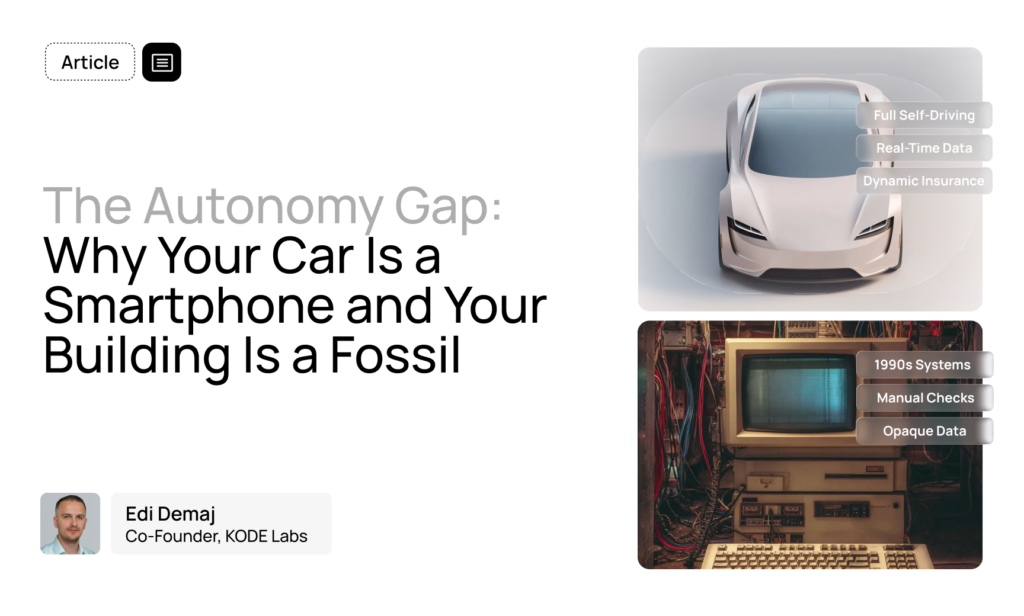
A self-driving car is a moving, safety-critical machine operating in public space. It navigates unpredictability, legal liability, human life, and physical risk.
And yet autonomy has now crossed a critical threshold: it is trusted enough to be measured, exposed, and priced in real time.
That is what Lemonade’s product actually signals. Not just confidence in autonomy, confidence in operational truth. The system is observable, verifiable, and reliable enough that a regulated financial product can depend on it.
That threshold matters.
Because buildings are static, controlled environments. They do not move at highway speeds. They do not share roads with humans. They do not face the same real-time safety constraints.
And yet the systems that run them still cannot reliably expose their own operational state — even to the people who own them.
This is the gap. And it is widening.
Buildings are not a niche sector. They are giants of infrastructure.
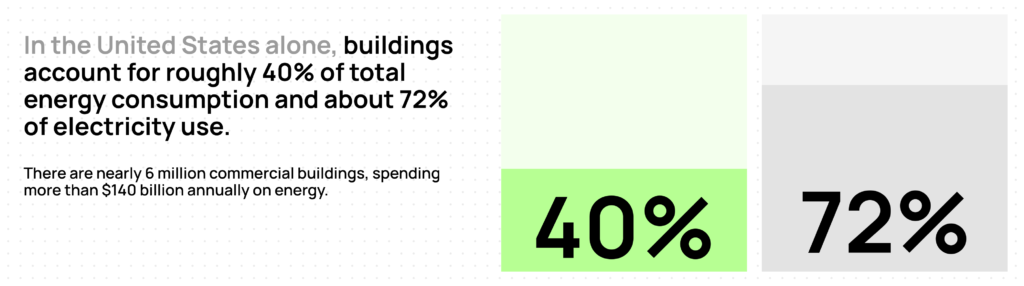
This is one of the largest controllable cost and emissions centers in the modern economy.
And yet the “brains” of these assets are often prehistoric.
In 2026, it is still common for a building’s operational visibility to consist of a workstation in a basement mechanical room, a graphical interface, and the human act of staring at an animated icon to see whether something looks like it’s working.
I began working in this industry at 18. Over two decades later, the core diagnostic approach has barely evolved.
The building automation world still revolves around BACnet, first published in 1995, and Modbus, introduced in 1979.
Yes, these protocols have evolved. But the dirty secret is that modernization is not a software update. It is a project. Upgrading requires gateways, certificates, commissioning, specialized labor, site visits, time, and often six-figure checks, just to move from one generation to the next.
Modernization shows up as capital expense and operational disruption, not as continuous improvement.
Meanwhile, the rest of the economy moved to API-first platforms, cloud-native infrastructure, over-the-air updates, and systems that get better every month.
Buildings did not.
In too many buildings, owners discover – after paying millions – that they do not actually control the operational truth of their own asset. Access to data is not assumed. It is mediated.
Exports aren’t supported. Documentation is incomplete. Diagnostics require specialists. Answers require site visits.
Even in newly delivered Class A buildings, owners can wait weeks just to understand what was installed and what data points even exist.
This is not an edge case.
It is systemic.
And it is not primarily a technology failure. It is a business model failure.
The dominant economic model rewards complexity.
Make systems hard to understand. Require specialists. Turn on-site visits into revenue. Treat documentation and access as optional.
Clean APIs reduce billable hours. Clear documentation reduces leverage.
So friction becomes the product.
This model survived because buildings were slow, opaque, and localized. That world is ending.
The same industrial giants announce their “next AI platform,” yet those platforms often struggle to integrate even with the vendor’s own installed base – without converters, gateways, and bespoke projects.
You cannot claim to be the operating system for buildings while charging customers to figure out which version of your own system they have.
You cannot sell the future while being unable to see the present.
Cybersecurity has become a convenient excuse to stay stuck.
Modern security is not obscurity. It is identity, segmentation, auditability, least privilege, and visibility. Keeping systems closed does not make them safer — it makes them harder to operate and harder to improve.
Here’s the uncomfortable truth: rebuilding the physical world takes decades.
Replacing every boiler, chiller, controller, and wire in the built environment is a multi-decade, trillion-dollar undertaking.
But software doesn’t have that timeline.
Software is the only lever that can move at the speed of energy prices, underwriting cycles, and climate mandates. A modern software layer can extract operational truth from the systems we already have, normalizing data, enabling remote visibility, and turning static automation into something measurable and improvable.
Waiting for a hardware refresh is how we lose another generation.
Operational truth is now valuable enough to power regulated financial products in real time.
Translate that to buildings.
Insurance priced on verified runtime and fault history. Policies covering only the most expensive and failure-prone systems. Underwriting based on live asset health instead of static questionnaires.
None of this is blocked by physics.
It is blocked by data access.
When autonomy becomes standard for moving machines, tolerance for manual, opaque, vendor-controlled “smart buildings” will collapse.
The finance, insurance, and energy sectors are waking up. They don’t want anecdotes. They want operational truth.
The next era of buildings will not be won by prettier dashboards or louder AI announcements.
It will be won by API-first, owner-controlled building infrastructure – a control plane that treats buildings like the hardware platforms they actually are.
Not the next software layer. Not the next pilot. Not the next promise.
The foundation.

Edi Demaj
Co-Founder, KODE Labs
News, insights and resources from the world of smart building management.
By clicking "Sign Up" you're confirming that you agree with our Terms and Conditions.
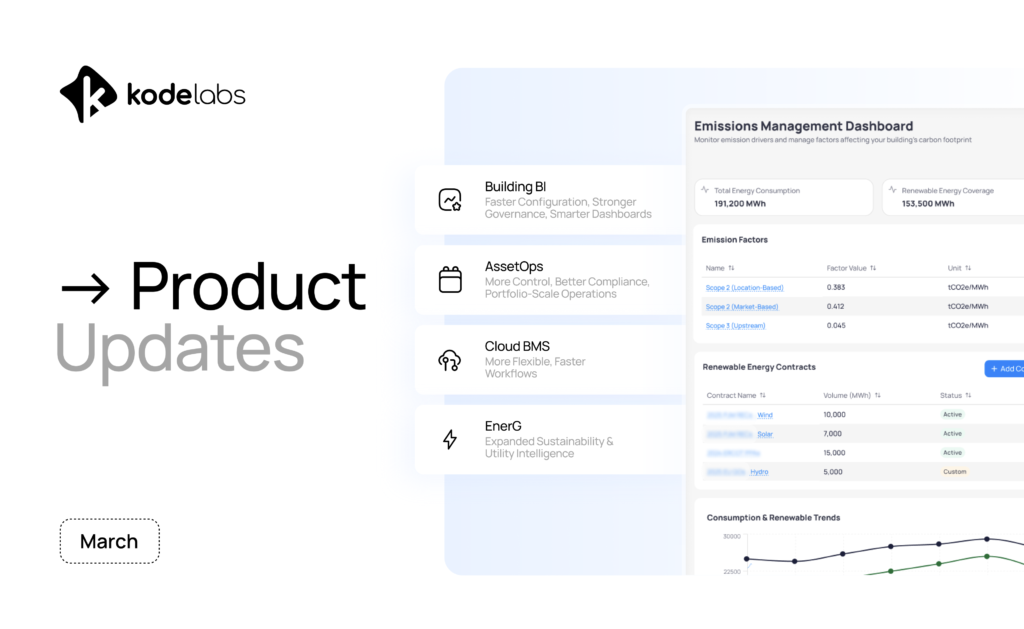
March at KODE was all about scale, control, and visibility. This month, we focused on making KODE OS easier to…
Read more
March expands the KODE OS integration ecosystem with new systems and updates, increasing visibility across security, energy, maintenance, and workplace…
Read more
Reporting season doesn’t wait for your data to be ready. Utility data management for ESG reporting has become a critical…
Read more