On this page
Subscribe to receive the latest blog posts to your inbox every week.
By subscribing you agree to with our Privacy Policy.
Ask a corporate real estate leader how their facilities management provider is performing, and the answer usually traces back to a single source: a report the provider wrote about itself.
The monthly scorecard. The SLA summary. The work order completion rate. All of it produced by the party being evaluated, from systems the client cannot see into, using definitions the client did not set.
No other function in a large company works this way. Finance does not let a vendor self-certify its invoices. Security does not take a supplier’s word that a control is in place. But facilities management, one of the largest controllable line items in a corporate real estate budget, runs on self-reported performance almost everywhere.
Nobody designed it that way on purpose. It accumulated. The FM contract came first, the reporting requirements were bolted on during negotiation, and the monthly performance pack became whatever the provider’s systems could produce. A decade later, that pack is the primary evidence of how the portfolio is running.
That creates a structural conflict. Most providers report honestly, and the data they produce is usually accurate as far as it goes. The problem is that it only goes as far as their own system. When the same party defines what “resolved” means, records when it happened, and reports the result upward, the incentive runs in only one direction. No amount of goodwill on either side changes that.
Consider what gets settled inside a provider’s own reporting, before anyone in your team sees a number.
When the SLA clock starts. Is it when the equipment failed, when someone noticed, when the ticket was logged, or when the technician was dispatched? Each definition produces a different response time. Only one of them reflects what the occupant experienced.
What counts as resolved. A work order closed after a site visit and a work order closed after verified equipment performance are the same line item in most reports. They are not the same outcome.
Whether a fault is new. The same pump failing every six weeks can appear as eight separate incidents, each closed within SLA, rather than one unresolved problem. The report shows compliance. The building shows a chronic fault.
What appears at all. Issues caught and fixed quietly by a good technician rarely make the report. Neither do the ones that never got logged.
What “good” looks like. Your best building and your worst can both report as compliant, because each is measured against its own baseline by its own team. You cannot see the spread, so you cannot manage it.
Each one is small on its own. Across sixty buildings and a five-year contract, they are not.
An air handler malfunctions on a Tuesday morning. Someone complains. A ticket opens at 9:40. A technician arrives at 10:15 and closes it at 11:00. Response and resolution both inside SLA. Green month.
What the report does not show: the unit had been cycling abnormally for eleven days, the same asset generated four similar tickets last quarter, and the floor did not hold a setpoint until 3pm. You paid for a fast response to a problem that should never have reached a ticket.
Repeat that across sixty sites and you are not managing facilities. You are managing a summary of them.
The instinct at renewal is to tighten the contract. Sharper SLAs, bigger penalties, more reporting requirements. That rarely changes the outcome, because it does not change who holds the data. A stricter SLA is still measured by the party it constrains.
The practical test is an invoice challenge. You are billed for emergency call-outs, overtime, and parts. The data that would justify or contradict the charge lives in the provider’s system, so reconciling it means asking them to produce it. In practice nobody contests a line item they cannot evidence, which means a penalty clause you cannot evidence is a penalty clause you will never enforce. That is real money sitting inside your cost per square foot, and it stays there through the next term.
Here is what most portfolios overlook. The buildings themselves are generating a factual account of what happened, continuously, whether or not anyone reads it.
Equipment runtime. Fault history. Alarm timestamps. Space conditions before, during, and after an intervention. Schedule overrides. Setpoint changes and who made them.
That record does not come from the provider’s ticketing system. It comes from the building and cannot be summarized generously, because it is not a summary. It is what the equipment did.
Most corporate real estate teams cannot reach it. The data sits inside controls systems commissioned by different contractors in different decades, each with its own interface and its own vendor relationship. Getting to it means asking the provider, which returns you to the original problem.
Reach it directly and you have a second source. Vendor reporting stops being the only account of what happened and becomes one account of what happened, checkable against another. That single change does more for accountability than any contract language, because it does not depend on the provider agreeing to be measured differently.
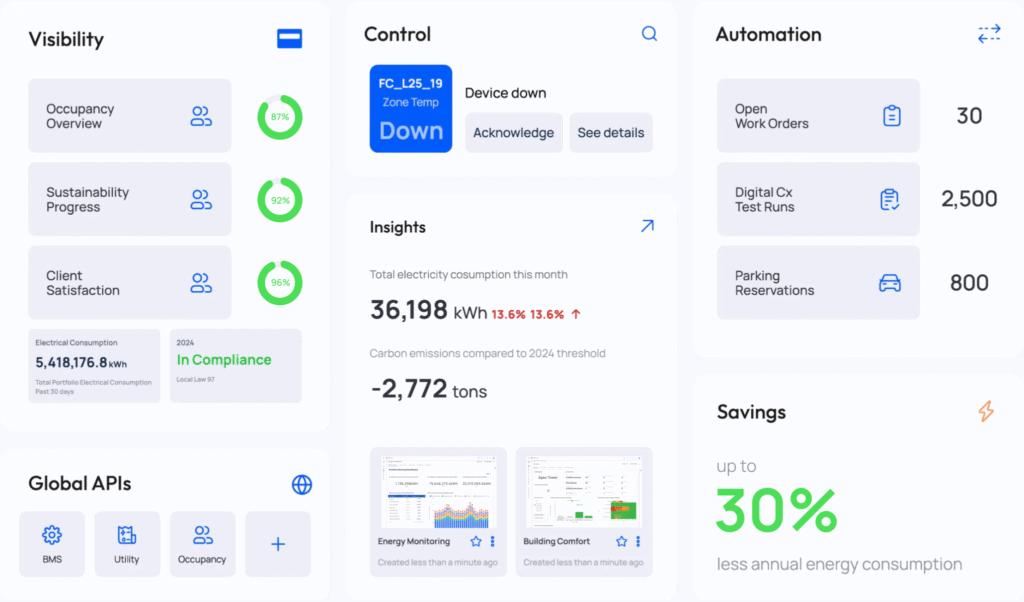
This is the layer KODE OS is built to give corporate real estate teams. It sits above the existing controls across a portfolio and captures what the equipment is actually doing, independent of any vendor’s reporting layer.
Building BI tracks SLA performance against your own data rather than the provider’s summary, and benchmarks site to site, so you can see whether a provider running twelve of your buildings is delivering the same standard in all twelve. An underperforming building shows up next to a comparable one instead of in isolation.
CMMS Integration validates work orders against equipment behavior. The ticket says the chiller was repaired Thursday. The trend data shows what the chiller did Thursday. The two either agree or they do not.
Alarms give the true incident timeline. When the fault started, not when someone noticed.
Bedrock runs its portfolio out of a national command center built on exactly this record. Reactive work orders fell roughly 25% in six months. The reduction came from seeing patterns before they became tickets, and from a shared record that made the conversation about the equipment rather than about the report.
Site FM teams often have the most to gain here, which surprises people. They are already the group asked to defend numbers they did not produce, in meetings where nobody in the room can settle a disagreement with evidence.
An independent operating record ends those arguments instead of adding to them. When both sides are reading the same timeline, the monthly review stops being a negotiation over whose version is right and becomes a short conversation about what to fix. That is less work, not more.
Whether you are 90 days from an FM renegotiation, working a lease event, or resetting the portfolio after an RTO shift, the question is the same.
If your FM provider stopped sending reports tomorrow, what would you still know about how your buildings are performing?
If the honest answer is that you would need the provider to tell you, the reporting structure is doing the work your governance is supposed to do.
To see what an independent operating record looks like next to your current FM reporting, we can walk through it using one of your sites. It takes about 15 minutes and does not require a procurement process to start.
Because the same provider being measured often controls the systems, definitions, and reporting used to judge its performance. That does not mean the data is dishonest, but it does mean the client has no independent way to verify what happened.
Not necessarily. A work order can be opened, responded to, and closed within SLA while the underlying equipment problem has existed for days or continues after the ticket is closed.
By comparing provider reporting against data generated directly by the building, including alarm timestamps, equipment runtime, fault history, setpoint changes, schedule overrides, and space conditions. This creates a second source of evidence rather than relying on the provider’s report alone.
Tighter SLAs and larger penalties do not solve the underlying problem if the provider still controls the data used to measure those SLAs.
Yes. For example, if a ticket says a chiller was repaired on Thursday, operational trend data can show whether the chiller actually returned to normal performance that day. The work order and equipment behavior either support each other or they do not.
KODE OS sits above existing building controls and captures equipment data independently of the FM provider’s reporting layer. Building BI can then measure SLA performance using the client’s own data and compare performance across sites, while integrations can validate work orders against actual equipment behavior.
News, insights and resources from the world of smart building management.
By clicking "Sign Up" you're confirming that you agree with our Terms and Conditions.
Originally posted on Mann Report Ask your facility manager how many vendors currently have remote access to your building. Most…
Read more
Originally published on Facility Executive. Integration and expanded policy mean federal building management platforms now require the same heavy security…
Read more
Originally published on The Capitol Forum. “When we began pursuing FedRAMP High authorization, we assumed the biggest challenge would be…
Read more