On this page
Subscribe to receive the latest blog posts to your inbox every week.
By subscribing you agree to with our Privacy Policy.
Smart building transformation doesn’t happen through technology alone. It requires teams that can coordinate across functions, solve complex challenges, and turn ambitious ideas into real outcomes for clients.
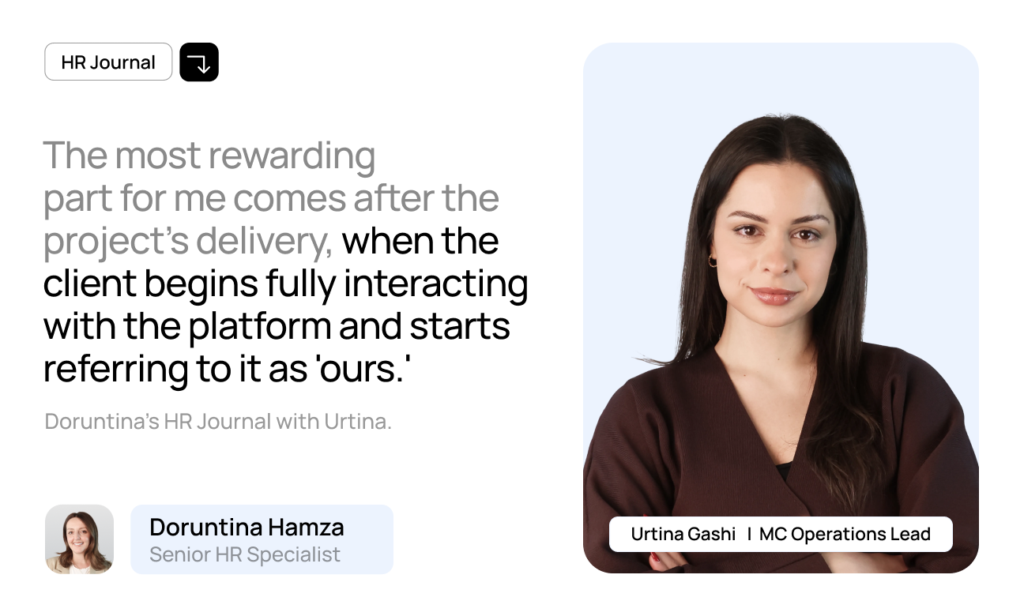
In this edition of HR Journal, we sit down with Urtina Gashi, Operations Lead for Mission Control at KODE Labs. Having grown through multiple client-facing and operational roles, Urtina shares her journey from Client Support to leadership, the lessons she’s learned about ownership and initiative, and how the Mission Control team helps drive successful project delivery and client outcomes across KODE’s smart building ecosystem.
In my current role at KODE, I oversee operations for our Mission Control Team, working closely with deployment teams, project managers, and client support to ensure we deliver the best possible experience for our clients.
My journey at KODE is incredibly meaningful to me because I’ve truly come full circle. I started in Client Support, helping to grow that team, and over the years, I found myself consistently working across Client Experience, Support, and Implementation. Those experiences ultimately led me to a role that brings together everything I enjoy most into one space.
One of the things I love most about my role is that there really is no “typical” day, in the best way possible. My focus is on ensuring the team operates efficiently, has the support needed to perform at 120%, and our clients are genuinely happy with both our product and delivery. Beyond that, it’s about ensuring that every effort we put in translates into meaningful impact and contributes to the organization’s growth. Everything in between is what makes each day exciting and rewarding for me.
The most important lesson I’ve learned is that almost anything can be achieved with discipline, follow-through, and trust in the mission behind what you’re doing. Initiative can show up in many different ways; sometimes it’s having an idea you strongly believe in, and other times it’s recognizing a gap or recurring challenge and choosing to take ownership of solving it.
I’ve learned that consistently showing up with commitment and accountability for what you own can unlock so much. That mindset has played a huge role in my growth as a leader. It’s also something I’ve learned directly from my experience at KODE. Being surrounded by people who embody that level of ownership and drive every day naturally brings it out in me as well, both professionally and personally.
I think they would say they finally came to life in a way that matches the people inside them. Before transformation, buildings are often full of disconnected systems, manual processes, and missed opportunities. Once integrated into KODE OS, they become spaces that communicate, adapt, and support the people operating them every day.
What excites me most is that we’re not just modernizing buildings technically, we’re helping create environments that are smarter, more efficient, and easier for teams to manage. If they could talk, I think they’d say they’ve gone from simply existing to actually working with purpose.
The most rewarding part for me comes after the project’s delivery, when the client begins fully interacting with the platform and starts referring to it as ‘ours.’ You watch them intuitively navigate solutions our team specifically built for their needs, and they begin sharing discoveries, efficiencies, or how the platform has naturally become part of their everyday workflow.
That’s the moment where it really clicks – we didn’t just deliver a product, we delivered value, excitement, and something that genuinely impacts the way they operate day to day.
I believe one of the biggest strengths of Mission Control is that we never stop at “no.” When we face a complex technical challenge, the mindset is never about whether something can be done, but how we can creatively find a way to make it happen. That mentality pushes us to think outside the box, collaborate across teams, and stay solution-oriented even when the path forward is not immediately clear.
At the same time, innovation only matters if it’s followed by execution. I try to encourage the team not only to bring ideas to the table but also to take ownership of seeing them through. Some of the best outcomes come from moments where we had to adapt quickly, problem-solve together, and stay persistent until we delivered the right solution for the client.
What makes me proud of our team is that we consistently rise to challenges with both creativity and accountability. We don’t just identify problems – we commit to solving them, and that’s where I think this value truly comes to life.
Urtina’s journey reflects the power of ownership, adaptability, and a commitment to continuous improvement. From supporting clients on the front lines to leading Mission Control operations, she has built her career by identifying opportunities, taking initiative, and following through on results.
Her perspective highlights what makes Mission Control successful: a team that embraces challenges, stays solution-oriented, and remains focused on delivering meaningful outcomes for clients. At KODE, innovation may spark the idea, but execution is what turns that idea into impact.
Coming soon, another HR Journal conversation. Stay tuned!

Doruntina Hamza
Senior HR Specialist, KODE Labs
News, insights and resources from the world of smart building management.
By clicking "Sign Up" you're confirming that you agree with our Terms and Conditions.
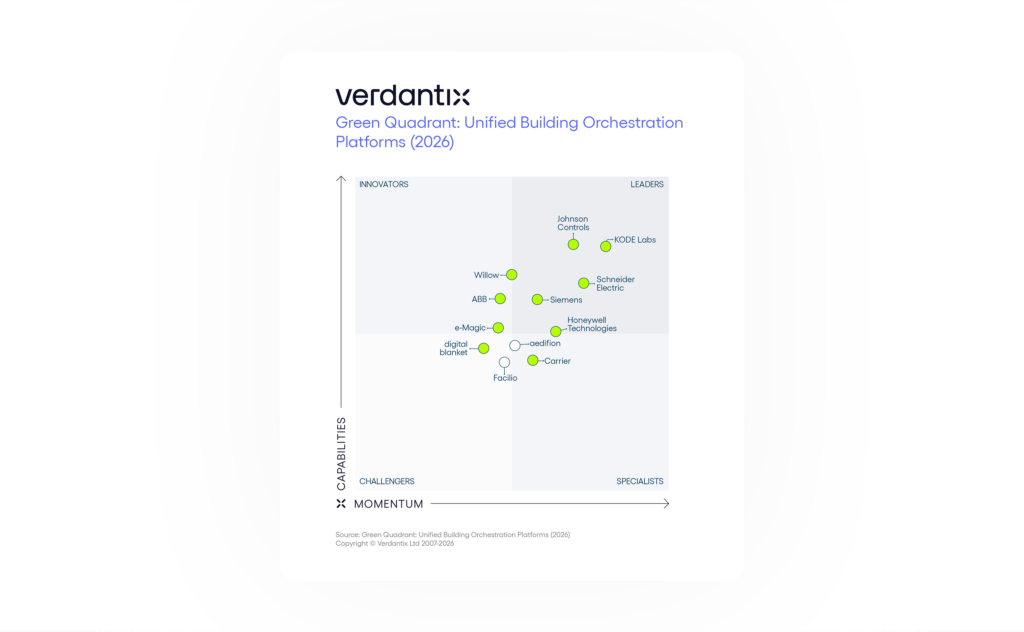
Verdantix has named KODE Labs a Leader in its Green Quadrant: Unified Building Orchestration Platforms (2026). More important than the…
Read more
Independent research recognizes KODE OS as the building operating system connecting fragmented systems, data and workflows across complex real estate…
Read more
September was about closing the gap between seeing and acting. Operational teams aren’t short on signals. Faults surface in FDD.…
Read more