On this page
Subscribe to receive the latest blog posts to your inbox every week.
By subscribing you agree to with our Privacy Policy.
Your tenant already knows there’s a problem. Why don’t you?
A conference room slowly warms throughout the morning. CO₂ levels climb during back-to-back meetings. One corner of the office never quite reaches the thermostat setpoint. By the time employees notice, productivity drops, service requests begin arriving, and facilities teams are already reacting to a problem that started hours earlier.
When the complaint comes in, your team is already behind.
A connected approach to tenant comfort brings indoor environmental measurements together with equipment performance, space information, and operational workflows. This helps teams detect developing issues, investigate likely causes, coordinate a response, and check whether conditions recover. Earlier detection creates an opportunity to act before a complaint, although results depend on sensor coverage, reliable data, and timely intervention.
Three facts help frame this approach:
For commercial real estate owners, every comfort issue carries consequences beyond a maintenance ticket. A building that consistently delivers a comfortable workplace gives tenants one less reason to look elsewhere when renewal time comes. Comfort has become part of the product.
Most workplace comfort issues develop gradually.
A failed damper, an overridden schedule, poor ventilation, drifting sensors, or an HVAC system struggling to keep pace with occupancy can slowly push conditions outside acceptable ranges. Temperature, humidity, and indoor air quality drift long before someone decides to report them.
Traditional building operations often discover these issues only after:
Instead of preventing poor experiences, operations teams spend their entire day responding to them.
Many buildings already monitor temperature, humidity, carbon dioxide (CO₂), or other indoor environmental conditions.
But knowing a room is warm doesn’t explain:
Environmental data answers what happened. Operations teams still need enough context to understand why it happened and what to do next.
Without that connection, teams end up with another dashboard instead of a faster path to resolution.
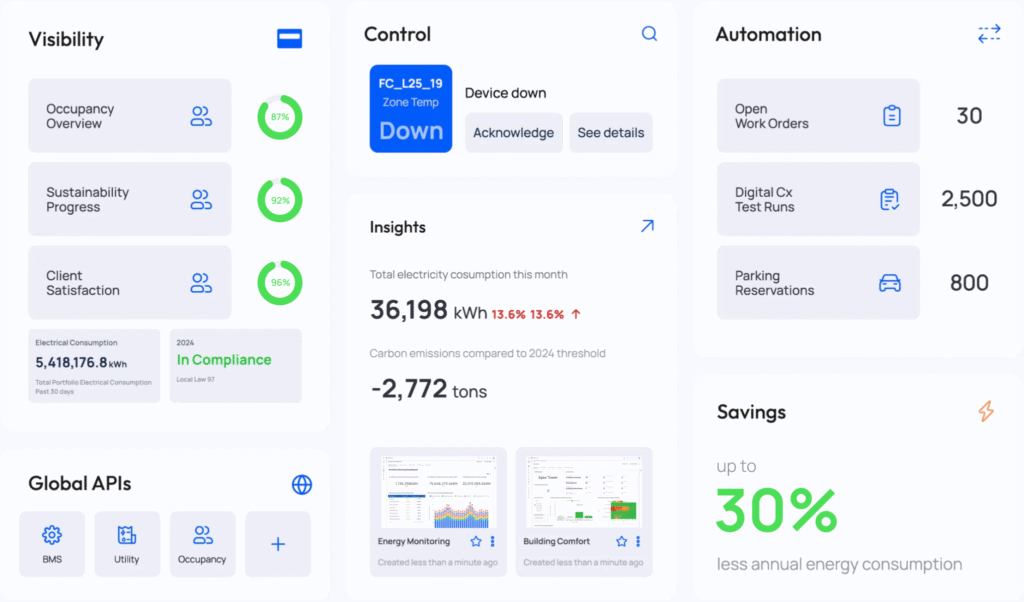
A connected comfort system brings environmental conditions together with building systems and operational workflows. It supports a repeatable process from detection through verification:
Consider an illustrative example: a conference room repeatedly warms during afternoon meetings. The temperature trend shows when conditions deteriorate. Equipment data then shows that airflow remains below its target while the room needs cooling. An engineer investigates the serving equipment, corrects the fault, and reviews subsequent occupied periods to confirm recovery.
The initial alert identifies a symptom. Connecting it to equipment performance gives the team a clearer investigation path.
KODE OS offers Building BI capabilities that support analysis and dashboards, while Digital Maintenance provides fault detection and diagnostics. Together, these capabilities can support comfort investigations using the systems and data connected at each property.
Tenant experience depends in part on how reliably the building performs. A space that is consistently too warm, too humid, or poorly ventilated can quickly become a tenant issue.
The operational side of workplace experience begins with consistently comfortable spaces.
When facilities teams can identify and resolve issues before occupants notice them, they reduce service requests, improve tenant satisfaction, and create a workplace that feels reliably comfortable every day.
Those outcomes become increasingly important as owners compete to attract and retain tenants in a market where experience matters as much as location.
Waiting for complaints means tenants become your monitoring system. A connected approach changes that dynamic.
Instead of discovering comfort issues after productivity is affected or service requests begin arriving, operations teams gain the visibility and context needed to identify problems early, investigate them quickly, and resolve them before they disrupt the workplace.
That’s the difference between monitoring indoor environmental conditions and delivering a connected comfort system.
It’s one example of unified building orchestration at work, and part of the approach behind our recognition as a Leader in the Verdantix Green Quadrant 2026.
Book a KODE OS Demo | Explore the Platform
A connected comfort system brings indoor environmental data, such as temperature, humidity, and air quality together with building systems and operational workflows. Instead of simply monitoring conditions, it helps teams identify anomalies, investigate their causes, coordinate corrective action, and verify that comfort has been restored.
Indoor air quality monitoring can help building teams identify conditions such as elevated CO₂ or other environmental changes before they become noticeable to occupants. When connected to building operations, that information can help teams address the underlying issue before it turns into a tenant complaint.
Yes. Continuous monitoring can identify temperature, humidity, and air quality conditions that are moving outside defined thresholds before occupants report discomfort. The operational value comes from using those signals to investigate and resolve the issue proactively.
Common comfort and indoor environmental indicators include temperature, humidity, and air quality measures such as CO₂. The specific thresholds depend on the building, space, occupancy, and operating requirements.
Monitoring tells you when conditions are outside acceptable thresholds. Managing comfort means connecting that information to the building systems, people, and workflows needed to understand the cause and resolve the issue.
KODE OS connects temperature, humidity, and air quality data with building operations, giving teams a way to identify comfort anomalies, investigate potential causes, coordinate action, and verify resolution.
News, insights and resources from the world of smart building management.
By clicking "Sign Up" you're confirming that you agree with our Terms and Conditions.
Originally posted on Mann Report Ask your facility manager how many vendors currently have remote access to your building. Most…
Read more
Originally published on Facility Executive. Integration and expanded policy mean federal building management platforms now require the same heavy security…
Read more
Originally published on The Capitol Forum. “When we began pursuing FedRAMP High authorization, we assumed the biggest challenge would be…
Read more