By KODE Team
On this page
Subscribe to receive the latest blog posts to your inbox every week.
By subscribing you agree to with our Privacy Policy.
Reporting season doesn’t wait for your data to be ready.
Utility data management for ESG reporting has become a critical issue as deadlines keep tightening. In April, GRESB opens, and CDP questionnaires drop. And behind every one of these deadlines sits the same question:
Can you actually trust the numbers you’re about to submit?
For most portfolio operators, the honest answer is: not entirely. And that’s not a people problem, it’s an infrastructure problem.
Over the last 12–15 months, we worked closely with enterprise sustainability teams managing complex multi-site portfolios. The pattern was consistent: teams were still patching together utility management by disconnected portals, spreadsheets, and scattered PDFs.
When that’s your foundation, things unravel fast:
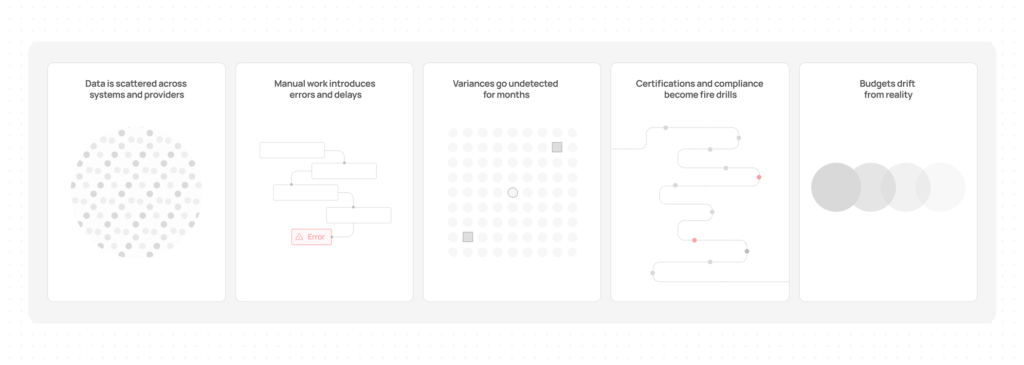
Here’s what that actually costs: Your best sustainability analysts are spending their time cleaning and stitching data instead of acting on it. Your finance team doesn’t fully trust the numbers behind the ESG narrative and your leadership is making capital and decarbonization decisions on a foundation that everyone quietly knows is fragile.
The organizations that figure this out first don’t just report faster, they report with confidence. The ones that don’t keep explaining why the numbers changed again.
EnerG was shaped by a direct and repeated ask from the organizations already using KODE OS: Give us the same level of transparency, auditability, and automation for utility and sustainability data that we have for building operations.
So we built EnerG as a centralized, AI-enabled utility intelligence platform, designed to turn fragmented utility, sustainability, and performance data into a system of record that enterprise portfolios can actually trust.
At its core, EnerG does three things:
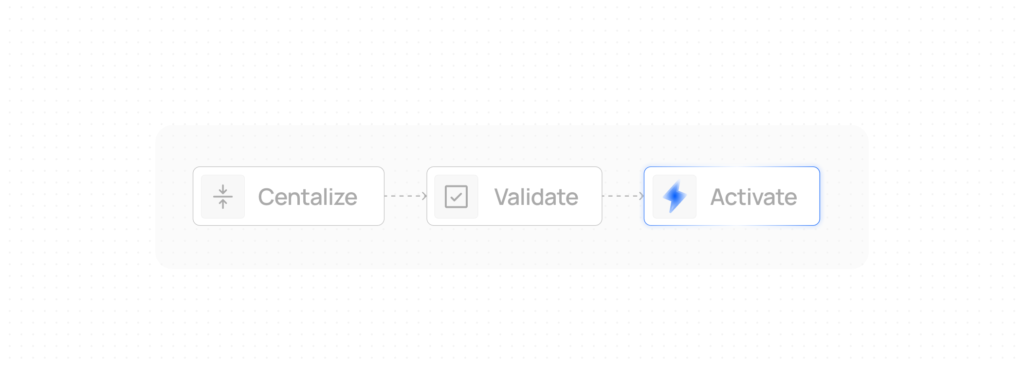
EnerG isn’t another dashboard to look at numbers. It’s built to replace the manual, fragmented work that keeps teams stuck in cleanup mode, not by making people work harder, but by turning utility data into a connected system: collected, validated, organized, and usable across the full portfolio.
EnerG supports multiple ingestion methods so organizations can match their existing infrastructure: secure portal connections, AI-enhanced OCR for PDF bills, APIs, SFTP, tenant billing data, and third-party integrations.
With EnerG: Your data arrives structured, normalized, and ready-at statement, account, and meter level-without anyone logging into utility portals or keying in line items.
Without it: Someone on your team is still downloading PDFs, copying numbers into spreadsheets, and hoping nothing got transposed. Every month.
Once data is ingested, EnerG uses an AI-driven Alert Center to detect anomalies and flag issues like: gaps, overlaps, duplicates, billing errors, and maintains a complete audit trail to support compliance and reporting readiness.
Think of it as fault detection and diagnostics, but for utility and meter data. Not “hoping the data is right,” but making validation automatic, visible, and traceable.
With EnerG: Issues surface before they reach your budget or your board deck. Every flag, comment, and resolution gets documented.
Without it: Errors sit undetected until an auditor or an investor asks a question you can’t answer cleanly.
EnerG normalizes utility data so teams can see performance across a portfolio, and compare sites, without spending weeks cleaning and reformatting. That normalization is also what makes the data AI-ready: consistent, structured, and usable for automated workflows as they evolve.
With EnerG: You benchmark buildings against each other on EUI, WUI, and GHG, trailing 12 months or any historical period, and know immediately where to focus.
Without it: You’re still assembling the comparison in a spreadsheet, and by the time it’s ready, the window to act has moved.
EnerG aligns sustainability targets with budgeting, capital planning, and efficiency initiatives, including scenario modeling and variance analysis that link decarbonization work to measurable ROI.
Targets cascade from corporate commitments down to individual buildings. Budgets factor in weather normalization, tariff trends, occupancy, and planned projects. Capital plans directly connect to the targets they serve.
With EnerG: Your CSO’s decarbonization commitment and your CFO’s budget live in the same system, validated against the same data.
Without it: Strategy lives in a presentation. Execution lives in a spreadsheet. And the gap between them grows every quarter.
GRESB. CDP. BERDO. ENERGY STAR. The reporting calendar is getting denser and the stakes are getting higher, $268 per excess metric ton under LL97, investor scrutiny on every CDP score, GRESB rankings that directly affect capital access.
With data integrity at the center, EnerG supports audit-ready ESG, investor, and regulatory reporting, reducing the manual collection and validation burden that typically turns every submission window into a scramble.
With EnerG: When GRESB opens on April 1 or CDP questionnaires drop in April, your data is already validated, normalized, and waiting. You submit with confidence, not anxiety.
Without it: You start every reporting cycle the same way: chasing missing bills, reconciling inconsistencies, and hoping you finish before the deadline.
The point of EnerG is the workflow. It’s designed so utility intelligence moves cleanly from data collection to decisions:
Utility ingestion → AI validation → Variance Detection → Budget Integration → Target Alignment → Scenario Modeling → Capital Planning → ESG & Investor Reporting
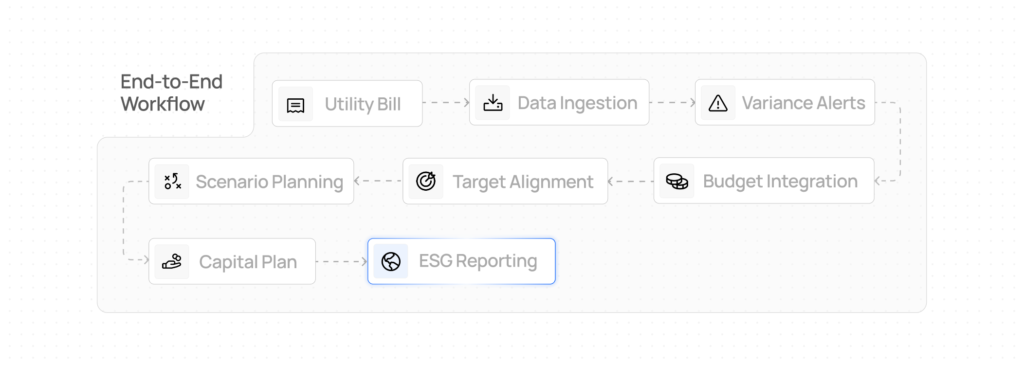
No handoffs, no rebuilding the model every month, and no blind spots between what sustainability promises and what finance can verify.
EnerG follows KODE Labs’ open data philosophy. It acts as an aggregation and intelligence layer while ensuring organizations maintain full ownership and accessibility of their data. You can share validated utility intelligence across internal cloud environments, enterprise data platforms, and sustainability reporting ecosystems, on your terms.
Powered by KODE OS, EnerG extends our ontology to unify utility, sustainability, operational, and financial data, with a focus on workflow-to-data-completeness. That foundation now sits within 200+ integrated data sources, from operational technology to utilities.
EnerG can be deployed as a standalone solution for utility-focused teams. It becomes significantly more powerful when connected to KODE OS, linking utility intelligence to building systems, asset performance, and optimization workflows across your entire portfolio.
The sustainability teams that already have clean, validated, centralized utility data will move through the next six months of reporting deadlines with clarity and confidence. They’ll benchmark accurately, submit on time, and answer investor questions without hedging.
The teams that don’t will do what they did last year: scramble, reconcile, hope nothing slipped through, and promise themselves they’ll fix it next cycle.
EnerG was co-developed with enterprise sustainability teams who were tired of that cycle, organizations managing complex portfolios who needed a single, auditable system for cost and carbon performance at scale. Teams that decided the risk of submitting with fragile data was no longer acceptable.
As we build toward a future driven by intelligent building automation and AI agents, EnerG lays the trusted data foundation required for the next generation of portfolio intelligence. It unifies the data needed to close the loop, from cost anomalies to equipment performance to verified savings, so AI agents can run daily workflows and complex regulatory reporting with confidence.
The question isn’t whether utility intelligence will become non-negotiable. It’s whether you’ll have it in place when it does.
Book a demo with our team to see EnerG and the full power of KODE OS.
Yes. EnerG is built with enterprise-grade security, encryption, and role-based access controls. The platform maintains full audit trails for data validation and reporting transparency, ensuring compliance with ESG, regulatory, and investor reporting requirements. Your data remains yours at all times, and EnerG is designed to integrate securely with your existing enterprise cloud and reporting environments.
EnerG supports multi-method data ingestion including secure portal connections, AI-enhanced OCR for PDF bills, APIs, SFTP, tenant billing integrations, and third-party metering systems. This flexibility allows organizations to tailor data collection to their infrastructure without disrupting existing workflows.
EnerG uses AI to automate data ingestion, detect anomalies, identify billing discrepancies (such as gaps, overlaps, or duplicates), and power variance analysis across meters and accounts. AI enhances speed and accuracy, but always within a transparent, auditable framework designed for enterprise governance.
Yes. EnerG leverages interval meter data and automated variance analysis to validate billing accuracy, detect discrepancies, and identify potential cost leakage. The AI-driven Alert Center flags issues early and maintains a complete audit trail for accountability.
Absolutely. EnerG centralizes utility and sustainability data into a single source of truth, helping organizations prepare audit-ready ESG, investor, and regulatory reports. Built-in data completeness verification ensures reporting readiness and compliance confidence.
No. EnerG is designed for enterprise real estate portfolios of all types, whether assets are fully digitized or operate with older infrastructure. It focuses on centralizing and validating utility and sustainability data, independent of the building’s systems and infrastructure.
EnerG was designed with transition in mind. KODE Labs supports secure migration of historical utility data, onboarding, and training to ensure continuity and minimal disruption. Many enterprise clients have adopted EnerG as a standalone solution or integrated it alongside KODE OS.
Yes. EnerG operates as a standalone utility intelligence solution and integrates seamlessly with KODE OS. It can also share validated data across internal data platforms, ERP systems, sustainability reporting tools, and enterprise cloud environments.
Organizations typically begin seeing improved data visibility and validation immediately after ingestion and onboarding. Because EnerG automates previously manual workflows, many teams experience faster reporting cycles and increased confidence within the first reporting period.

KODE Team
News, insights and resources from the world of smart building management.
By clicking "Sign Up" you're confirming that you agree with our Terms and Conditions.
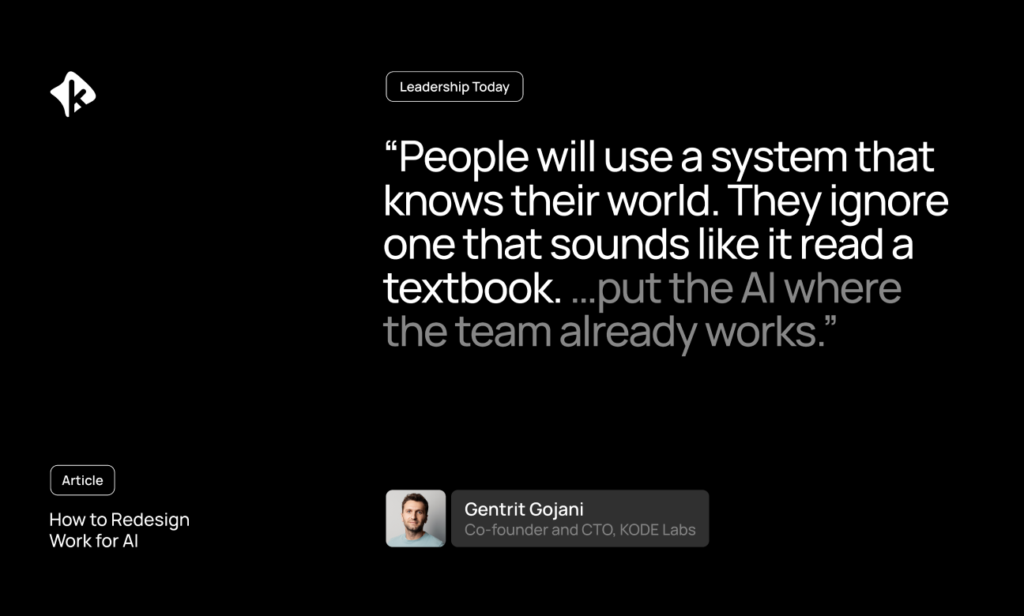
Originally published on Leadership Today To redesign work for AI, leaders have to look beyond adding new technology to existing jobs…
Read more
For commercial real estate owners, utility costs are easy to think of as a monthly expense to reconcile, report and…
Read more
August was about making scale easier. As portfolios grow, operational complexity grows with them. More maintenance work needs to be…
Read more