By Edi Demaj
On this page
Subscribe to receive the latest blog posts to your inbox every week.
By subscribing you agree to with our Privacy Policy.
Originally published on Facility Executive
The next phase of facility management relies on unified data streams to optimize building performance, drive efficiency, and shift from reactive to predictive maintenance.
The commercial real estate industry has spent the better part of a decade digitizing buildings. Sensors have multiplied; dashboards have expanded. Analytics platforms, occupancy tools, energy applications, maintenance software, and AI-driven systems have entered the market, promising smarter operations and autonomous buildings.
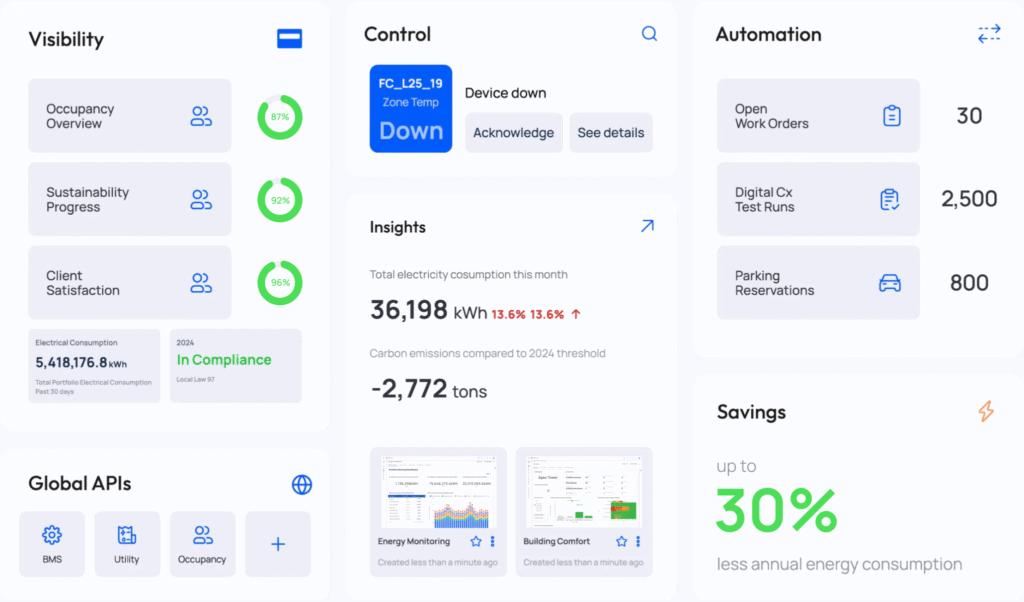
On paper, commercial buildings have never been more technologically advanced. Yet for many facilities teams, it doesn’t always feel that way. The issue isn’t that buildings lack the technology; it’s that the technology rarely works together in a coordinated way.
A typical commercial building now operates across five to 15 separate systems — from building management platforms to utility portals, often sourced from different vendors, built on different protocols, and managed through distinct interfaces. Each system generates operational data, while very few create operational cohesion.
This contradiction is increasingly defining the future of facilities management. Buildings are becoming more connected, but operations are not necessarily becoming more unified. In order to leverage the advantages offered by AI and other technology, we need to close that gap.
The industry has largely treated digitization itself as progress, but digitization alone does not foster operational intelligence. Adding more dashboards does not automatically improve building performance, and more software does not necessarily produce smarter outcomes.
The next phase of building operations will depend less on collecting data and instead focus on turning siloed systems into coordinated infrastructure. The future of facility management will depend on moving from visibility to action: connecting systems, contextualizing information, detecting issues earlier, and enabling teams to respond from the same environment where problems are identified.
Facility teams increasingly work within fragmented technology stacks that were never designed to function cohesively. Because data exists across disconnected systems, teams must juggle multiple dashboards and vendor interfaces simply to piece together a partial understanding of what’s happening inside the building.
While data is available, visibility alone does not create operational intelligence.
This distinction matters even more as AI enters our stacks. AI systems cannot operationalize fragmented data effectively. If building systems remain disconnected, the AI layer simply inherits that fragmentation.
The challenge is not simply seeing more information. It is enabling systems, workflows, and people to act cohesively around that data. Through contextualization, buildings become operationally coherent, creating the foundation needed for meaningful AI readiness at portfolio scale.
Fragmentation rarely presents itself as a single catastrophic failure. More often, it accumulates quietly across thousands of operational inefficiencies that compound over months and years.
Comfort complaints, energy waste, and maintenance issues are frequently identified only after they have already affected occupants, equipment performance, or operating costs. A scheduling conflict between occupancy systems and HVAC equipment might go unnoticed until an entire floor is conditioned unnecessarily overnight. A failed sensor may remain undetected for weeks because alarms, equipment histories, and maintenance workflows exist in separate systems. This fragmentation creates operational drag across the entire building. More importantly, it frustrates and annoys your tenants and increases your expenses.
Meanwhile, teams spend valuable time reconciling reports instead of optimizing performance. Decision-making slows because systems cannot communicate effectively. The result is not simply inconvenience. It is measurable operational, financial, and workforce strain.
These blind spots become particularly noticeable at the portfolio scale. A facilities manager responsible for dozens of buildings may technically have access to enormous amounts of data while still lacking a consistent understanding of how those assets are performing collectively. Different buildings operate on different vendor stacks, distinct workflows, and variable reporting structures. The consequence is that operational consistency becomes extraordinarily difficult to achieve.
Research from Lawrence Berkeley National Laboratory found that 15%–30% of commercial building energy is wasted due to building system faults, poor controls, and HVAC inefficiencies.
Within the first week of operating in a 400,000-square-foot commercial building, KODE Labs found HVAC equipment that could not adequately heat or cool occupied space, failed sensors, and two entire floors where lighting systems were running continuously, 24 hours a day. Once systems and operational workflows were unified, the building reduced energy consumption by 7% from baseline, while improving tenant comfort.
The significance of such examples is not the technology itself. It is what coordinated visibility makes possible. As data begins to move cohesively between systems, facilities teams are shifting toward predictive and coordinated operational models because a reactive approach is inefficient and increasingly difficult to sustain.
In practice, unified operations depend on five interconnected capabilities.
The evolution of building technology is also reshaping the role of facilities professionals.
Facility management is becoming increasingly digital, data-driven, and cross-functional. At the same time, operational complexity continues to rise while many organizations face workforce shortages and growing performance expectations. As a result, the role of facilities professionals is shifting away from manual oversight and toward strategic management.
Future facilities teams will spend less time manually monitoring equipment, investigating isolated alarms, navigating disconnected systems, and reconciling reports across multiple platforms. Instead, their focus will increasingly center on interpreting operational insights, coordinating workflows, managing building performance, and optimizing building systems across entire portfolios.
In other words, the most effective operational environments will not eliminate human expertise; they will augment it. That becomes even more important as AI tools mature across the built environment. AI may help facilities teams surface anomalies, identify inefficiencies, prioritize maintenance, and automate repetitive tasks, but those systems are only as effective as their operational foundations. Buildings still require judgment, contextual decision-making, and coordinated response. No technology, no matter how connected, will alter that. What will change, and what needs to change, is the connected infrastructure supporting human expertise.
The next phase of facilities management is unlikely to be defined by how many technologies buildings contain. Instead, it will be focused on how effectively those technologies can work together, as coordinated environments will gain a significant advantage over fragmented ones.
The buildings that succeed in the next decade will not necessarily be the ones with the most sensors, dashboards, or AI applications. They will be the ones capable of turning siloed data into action through coordinated operational intelligence.
Because before buildings can become truly AI-enabled, they first must become operationally unified.

Edi Demaj
Co-Founder, KODE Labs
News, insights and resources from the world of smart building management.
By clicking "Sign Up" you're confirming that you agree with our Terms and Conditions.
Originally posted on Mann Report Ask your facility manager how many vendors currently have remote access to your building. Most…
Read more
Originally published on Facility Executive. Integration and expanded policy mean federal building management platforms now require the same heavy security…
Read more
Originally published on The Capitol Forum. “When we began pursuing FedRAMP High authorization, we assumed the biggest challenge would be…
Read more