By KODE Team
On this page
Subscribe to receive the latest blog posts to your inbox every week.
By subscribing you agree to with our Privacy Policy.
A hospital building management system is the software that monitors and controls a facility’s mechanical, electrical, and life-safety equipment: HVAC, air handling, chillers, pressure and humidity in clinical spaces, metering, and alarms. In most large health systems, however, that “system” is actually several systems. Different buildings were commissioned in different decades by different contractors, so each runs its own vendor’s controls.
The result is fragmentation. Operators log into one interface for one hospital and a different interface for the next. Alarms are configured inconsistently. Historical data sits siloed by vendor. And leadership has no single view of equipment health, schedule compliance, or energy performance across the estate.
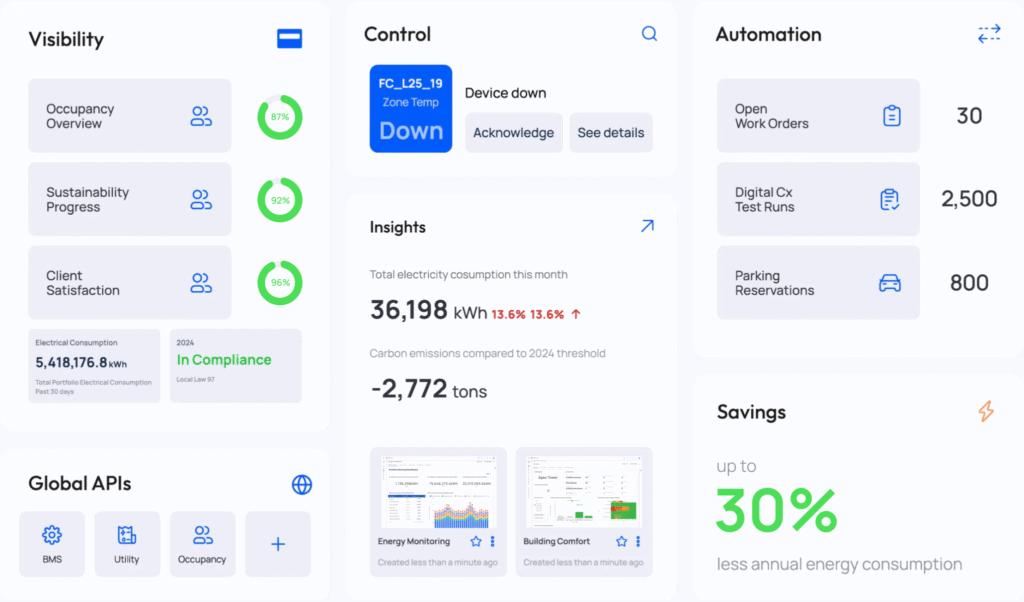
A modern approach solves this with a vendor-agnostic building operating system: a unified layer that sits above the existing controls, normalizes the data, and presents everything through one interface. The underlying hardware stays in place, and the experience becomes one.
A hospital building management system should unify your portfolio, not add another silo to it.
A hospital building management system built as a vendor-agnostic operating layer lets a health system monitor, command, and optimize every facility from one interface, without ripping out existing controls. One large multi-site health system did exactly this: it replaced three disconnected BMS front-ends with a single platform spanning its entire portfolio, and operators now resolve issues instead of hunting for them.
Here is what the deployment delivered:
The health system in this case study operated a fragmented front-end environment spanning three different BMS vendors across a portfolio of 80+ facilities. Because the interfaces were disconnected, operators switched constantly between them, alarm logic varied site to site, and no one could see equipment health portfolio-wide.
The stakes were unusually high. Hospitals are not office parks:
Any transition therefore had to preserve clinical safety while delivering operational improvement. In other words, the migration could not introduce a single moment of risk.
In healthcare, unifying building controls is a clinical-safety project as much as an IT one.
The health system deployed a smart building platform as a unified operating layer above its existing server infrastructure. Data from the three vendor systems was integrated, normalized, and surfaced through one web and mobile interface. Here is how a deployment like this works, step by step.
Takeaway: The safest migration path unifies the experience on top of existing controls rather than replacing them.
The deployment put a full set of capabilities into production across the portfolio:
One platform replaced a stack of disconnected tools with monitoring, commissioning, analytics, and automated dispatch in a single place.
When a health system outgrows its fragmented controls, it faces a choice: standardize on one manufacturer’s stack (rip-and-replace) or unify with a vendor-agnostic layer. The comparison below shows why large, mission-critical portfolios tend to choose the latter.
| Criteria | Vendor-Agnostic Operating System | Rip-and-Replace (Single Vendor) | Best for |
|---|---|---|---|
| Clinical downtime risk | Low; existing controls stay live | High; field devices are swapped | Vendor-agnostic |
| Time to portfolio-wide value | Fast; integrate and normalize | Slow; re-install per building | Vendor-agnostic |
| Capital cost | Lower; reuses installed base | Higher; new hardware everywhere | Vendor-agnostic |
| Future flexibility | High; add security, IoT, lighting via API | Locked to one vendor roadmap | Vendor-agnostic |
| Single-vendor accountability | Requires strong integration partner | Simple, one throat to choke | Rip-and-replace |
For complex, 24/7 healthcare estates, a vendor-agnostic operating system delivers unification without the clinical risk of replacing live controls.
| Metric | Before | After |
|---|---|---|
| BMS front-end interfaces | 3 separate vendors | 1 unified platform |
| Facilities on one platform | 0 | 80+, portfolio-wide |
| Devices monitored in real time | Siloed by vendor | 100,000+ normalized |
| Fault detection routines | Inconsistent, manual | 200+ automated |
| Fault-to-work-order handoff | Manual triage | Automated into CMMS |
Independent research points the same direction: analysts note that hospitals adopting integrated building automation can meaningfully cut operating costs while improving continuity of care (HealthTech Magazine, 2025).
The measurable win is consolidation, from three fragmented systems to one continuously monitored platform.
The outcomes showed up in daily work as much as in dashboards.
“Operators now spend their time resolving issues, not finding them. That shift, from hunting across three systems to acting inside one, is the real return.” (Smart Building Solutions Lead, KODE Labs)
Unification turned facilities teams from fault-hunters into fast responders.
One platform serves distinct roles, from the OR to the energy office, through role-based access.
A hospital building management system does not have to mean another vendor silo. By unifying a fragmented, multi-vendor portfolio on a vendor-agnostic operating layer, a leading health system consolidated 80+ facilities and 10+ million square feet into one platform, preserving clinical safety while turning fault-hunting into fast resolution. The lesson for any large healthcare estate is that unification and continuity are not in tension; the right architecture delivers both.
Ready to see what one platform could do for your portfolio?

KODE Team
News, insights and resources from the world of smart building management.
By clicking "Sign Up" you're confirming that you agree with our Terms and Conditions.

Driving Integration, Efficiency, and Tenant Experience in Complex Urban Environment A major mixed-use development in one of Europe’s busiest capitals…
Read more

QuadReal, headquartered in Vancouver, oversees an impressive 10,000+ residential suites across Canada, the US, UK, and Australia with $61.2 billion…
Read more

A leading healthcare institution partnered with KODE Labs to address the diverse and highly specialized operational needs of its extensive…
Read more