On this page
Subscribe to receive the latest blog posts to your inbox every week.
By subscribing you agree to with our Privacy Policy.
A Corporate Facilities Management leader rarely spends the day inside a single building. Instead, they’re coordinating maintenance teams, responding to operational issues, balancing priorities across dozens or even hundreds of sites, and making decisions that keep the entire portfolio running efficiently.
Every decision depends on having the right operational context. When building systems, maintenance records, and team updates live in separate places, understanding what needs attention, and making sure issues are fully resolved, becomes far more difficult.
Here is how that day typically unfolds, and how it transforms with KODE OS.
The day begins with updates from across the portfolio. Overnight alarms, maintenance requests, comfort complaints, and technician notes arrive from multiple systems and regional teams.
One office stands out. Several employee comfort requests were submitted the previous day, while an HVAC alarm was triggered shortly before the building closed that evening. Before deciding what needs immediate attention, the Corporate FM Leader spends time piecing together what actually happened and where to focus first.
Maintenance records show technicians have already visited the building more than once, but it’s still unclear whether they’re dealing with a recurring equipment issue, an isolated event, or something affecting similar buildings elsewhere in the portfolio. Without understanding the root cause, every additional truck roll risks bleeding unnecessary maintenance costs while the underlying issue continues.
Finding the answer means reviewing different systems, checking maintenance history, and reaching out to the regional Facilities team before the next steps can be determined.
Once the issue has been reviewed, the Facilities team is asked to investigate further. Throughout the day, updates arrive by phone, email, and chat, making it difficult to understand what’s already been completed, what’s still in progress, and whether additional support is needed.
While the investigation continues, the Corporate FM Leader must also keep the rest of the portfolio moving.
While one building is being investigated, new requests continue arriving from across the portfolio.
Balancing reactive issues, planned maintenance, and ongoing projects requires constant coordination across teams, systems, and locations before priorities can be adjusted.
By the end of the day, work has been completed across several buildings, but confirming whether the original issue has actually been resolved often takes another round of calls, emails, and status updates.
Some questions remain unanswered until the next morning, making it difficult to know where to focus first when the day starts again.
Keeping facilities running efficiently is about understanding why it’s happening, coordinating the right people, and confirming the issue has been resolved, and not just about knowing something is wrong.
KODE OS connects building systems, operational workflows, asset performance, and Facilities teams in one platform, giving Corporate FM Leaders the operational context they need to keep work moving across every building.
Here’s how the same day unfolds with KODE OS.
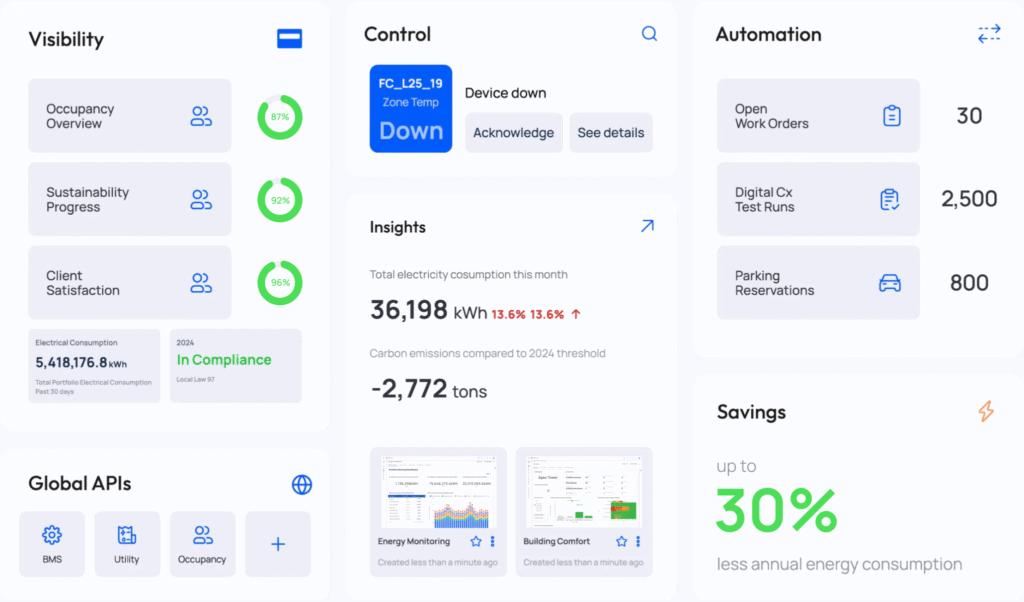
The day begins with a connected view of the portfolio. Instead of logging into multiple systems, the Corporate FM Leader immediately sees overnight operational activity, maintenance requests, equipment alarms, and building performance in one place.
KODE OS automatically highlights that the comfort complaints and HVAC alarm from one office are related, helping the leader quickly identify where attention is needed first.
Selecting the building reveals the full operational picture. Equipment history, historical performance, previous maintenance activity, and current building conditions are already connected, making it easier to determine whether the issue is isolated or part of a recurring operational pattern.
With the right context available, the Corporate FM Leader can confidently determine the next steps and involve the right team.
The issue is shared with the regional Facilities team through KODE OS, along with the operational context they’ve already reviewed. Technicians arrive with a clear understanding of the problem, while updates remain visible in the same platform as work progresses.
Instead of chasing emails or requesting status updates, everyone works from the same information while the Corporate FM Leader continues overseeing the rest of the portfolio.
With the immediate issue in progress, attention shifts back to the wider portfolio.
Using KODE OS, the Corporate FM Leader reviews maintenance activity across regions, identifies buildings with recurring issues, and ensures teams are focused on the work that will have the greatest operational impact. Having a connected view of facilities operations makes it easier to balance resources and maintain consistent service across every location.
As technicians complete their work, updates flow back into KODE OS alongside live building performance.
Rather than simply seeing that a work order has been closed, the Corporate FM Leader can confirm the issue has been resolved, verify building performance has returned to normal, and quickly identify whether similar issues are appearing elsewhere in the portfolio.
By the end of the day, the highest-priority work is already underway, Facilities teams are aligned, and progress is visible across the portfolio.
Instead of spending the day chasing updates across disconnected systems, the Corporate FM Leader has a connected view of operations, knows where work stands, and can confidently focus on keeping every building performing at its best.
Seeing what’s happening is only the first step. Keeping facilities running efficiently requires understanding why issues occur, coordinating the right response, and confirming they’re resolved.
KODE OS gives Facilities leaders the visibility, workflows, and operational intelligence they need to prioritize work, coordinate teams, and keep every building performing at its best.
See the Day-to-Day Workflow with KODE OS | Explore the Platform
News, insights and resources from the world of smart building management.
By clicking "Sign Up" you're confirming that you agree with our Terms and Conditions.
Originally published on Facility Executive. Integration and expanded policy mean federal building management platforms now require the same heavy security…
Read more
Originally published on The Capitol Forum. “When we began pursuing FedRAMP High authorization, we assumed the biggest challenge would be…
Read more
Verdantix has named KODE Labs a Leader in its Green Quadrant: Unified Building Orchestration Platforms (2026). More important than the…
Read more