On this page
Subscribe to receive the latest blog posts to your inbox every week.
By subscribing you agree to with our Privacy Policy.
Every day, Corporate Real Estate leaders make decisions that affect hundreds of people, multiple buildings, and millions in operational costs.
To make those decisions confidently, they need a complete view of portfolio performance. When information is spread across different buildings, systems, and teams, identifying priorities quickly becomes a challenge.
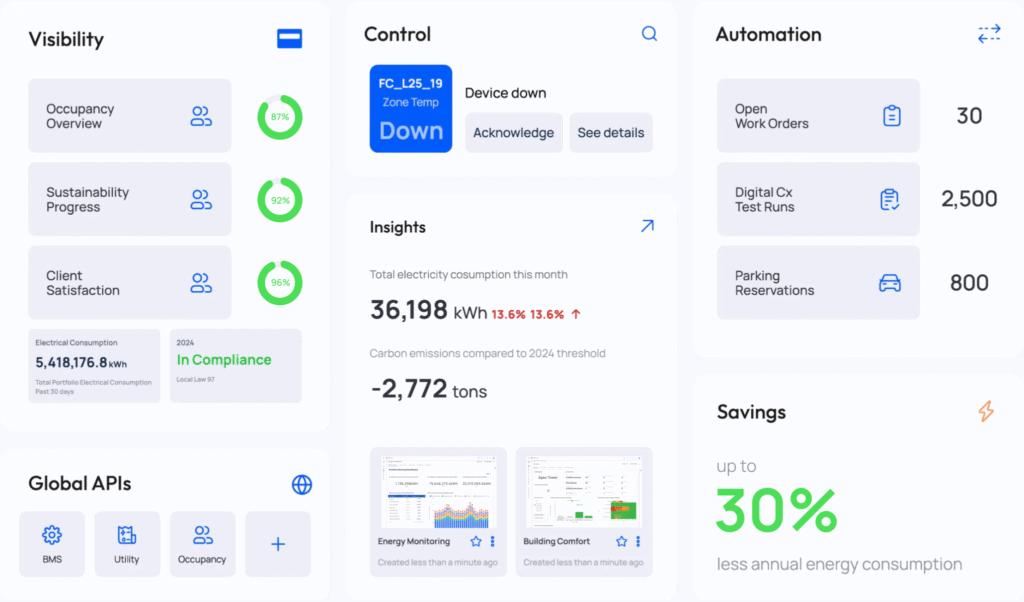
With KODE OS, portfolio data, building performance, and operational insights are connected in one place. This gives leaders a clearer view of their properties and the ability to take action faster.
Let’s take a look at what a typical day looks like for a Corporate Real Estate leader using KODE OS.
Instead of waiting for quarterly utility statements or delayed facility recaps, the morning starts with a single, live portfolio view. The Corporate Real Estate leader instantly spots an anomaly in a flagship downtown asset: energy intensity ($/sq ft) spiked 22% this month.
Drilling down into the asset level, KODE OS overlays occupancy telemetry with HVAC and BMS performance data. The issue is clear: off-hours climate control is running at full load on empty floors. So, instead of it being a simple maintenance glitch, it is actually thousands of dollars in wasted OpEx actively eating away Net Operating Income (NOI).
Instead of playing middleman between regional managers and vendors, the Corporate Real Estate leader tags the Facilities team directly inside KODE OS with complete system context. The FM team gets exact asset diagnostics to fix the setpoint error, while the CRE leader tracks resolution live with no check-in meetings required.
Attention shifts from single-building issues to long-term portfolio ROI. Using KODE OS carbon tracking and energy analytics, the Corporate Real Estate leader compares energy intensity across regional assets, easily identifying which underperforming sites need targeted CapEx retrofits to hit corporate ESG targets.
Preparing for an executive board meeting used to mean spending hours assembling spreadsheets from five vendor portals. With KODE OS, live metrics on portfolio occupancy, carbon reduction, and OpEx savings are pulled into executive-ready reports in just a few clicks.
The workday ends with complete clarity. Wasteful spending was caught before utility bills arrived, facility teams are focused on highest-impact tasks, and C-suite reporting is complete. The Corporate Real Estate leader leaves the office knowing every square foot is driving business value.
Corporate Real Estate leaders shouldn’t spend their days chasing facilities updates and cobbling together spreadsheets for board meetings.
Through connected data, operational insights, and portfolio-wide visibility, KODE OS empowers Corporate Real Estate leaders to make informed investment decisions across every building. With KODE OS, every CAPEX decision is backed by operational context, helping reduce OpEx, maximize ROI, and improve long-term portfolio performance.
See a Demo | Explore the KODE OS Platform
News, insights and resources from the world of smart building management.
By clicking "Sign Up" you're confirming that you agree with our Terms and Conditions.
Originally posted on Mann Report Ask your facility manager how many vendors currently have remote access to your building. Most…
Read more
Originally published on Facility Executive. Integration and expanded policy mean federal building management platforms now require the same heavy security…
Read more
Originally published on The Capitol Forum. “When we began pursuing FedRAMP High authorization, we assumed the biggest challenge would be…
Read more