By KODE Team
On this page
Subscribe to receive the latest blog posts to your inbox every week.
By subscribing you agree to with our Privacy Policy.
Walk the floor at any CRE technology conference this year, and the booths blur together. AI. Single pane of glass. Portfolio intelligence. Decarbonization. Different logos, the same handful of phrases, the same conviction. The pitches are nearly identical, which tells you the buyer’s problem was never a shortage of options. It’s the absence of shared criteria, the test that separates platforms that can operate a portfolio from platforms that can only report on one.
The stakes have rarely been higher. Margins are tight, efficiency is where returns are won or lost, and the know-how that keeps buildings running is increasingly hard to keep in-house. Meanwhile, every vendor sells AI, even though most portfolios sit on a data foundation too fragmented for it to mean anything.
Most evaluations fail at the same spot anyway: they treat this like software procurement, scoring vendors against a feature checklist, when it’s closer to choosing an operating partner for the next ten years of the portfolio. The questions that decide that outcome rarely appear on an RFP template. Here are the eight that should.
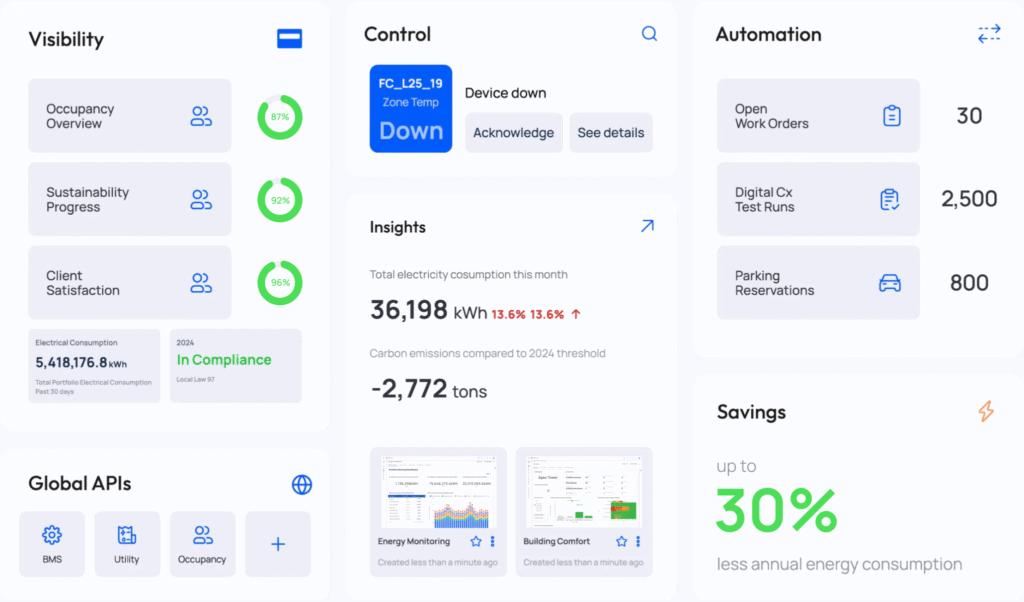
This is the question underneath all the others, and most platforms quietly fail it. The answer is a tour of dashboards and AI-flavored analytics: a system that watches your buildings and flags a problem, but can’t act on it. A reporting tool tells you an air handler drifted out of sequence at two in the morning, but to correct it, your operator still has to log into two or three separate systems.
Buildings are full of sensors that lie. A status reads “running” while the unit is off, and a platform that can only read those points inherits the lie and passes it back to you as truth. What’s needed underneath is an ontology that standardizes the data, cleaning and normalizing it into one reliable model, rather than a layer that just displays whatever the sensors claim.
The deeper test is whether it can write back to the equipment at all, so an operator acts in one place instead of toggling between systems. The business question is plain: does a comfort complaint get resolved before the tenant picks up the phone, or after, because that gap is what tenant satisfaction is made of. It’s worth seeing what a write-back operation looks like in practice before taking a vendor’s word for it.
The risk here hides in the implementation plan, not the price. Some platforms, typically the large OEM systems, expect you to standardize on their stack, which quietly turns a software subscription into a capital project you repeat building by building. The capital in your portfolio is already in the ground: the controllers, the sensors, the BMS that, whatever its limits, works. A platform that requires you to tear that out re-spends it and stalls the rollout before the second building. One that sits on top and unifies what’s already there protects the investment instead.
Most independent platforms clear this bar; they’ll sit on top of what you already run without forcing a replacement. So the harder version of the question isn’t whether a platform connects, but what it costs to leave. Some connect to your systems while routing everything through proprietary protocols and a closed data model, so your operational history and your integrations live inside their walls. Standardizing on a single vendor’s stack feels efficient on day one and becomes the reason you can’t move on day one thousand.
That is where vendor lock-in begins. Press on whether the platform is genuinely hardware- and vendor-agnostic, or whether “open” quietly means open only to the systems the vendor prefers, which is lock-in wearing a friendlier word. The mechanics of sitting on top of any BMS without a rip-and-replace are worth understanding before the distinction gets buried in a statement of work.
Every vendor can show you year one. The demo is clean, the launch goes well, and the savings land where the business case promised. Far fewer can tell you what month thirty looks like. That’s what decides whether you bought an operating partner or an expensive screen.
Buildings drift. Equipment degrades. The control sequences tuned at go-live fall out of calibration, and the savings you booked in year one bleed away unless something actively holds them in place. A tool that only reports charts the decline accurately and stops there. The platforms that hold the gains do more than report: they treat commissioning as continuous, not a one-time handover, testing equipment automatically overnight; catching degradation before it becomes an emergency truck roll; verifying a vendor’s fix actually held instead of taking the closed work order on faith.
There’s a workforce dimension that rarely makes the business case but should.
A lot of how a building runs lives with a handful of experienced operators rather than in any system, and that creates continuity risk when people move on. A platform won’t turn that into a plain-English manual, but standardizing the data and putting shared operating logic, schedules, and alarm policies in one place makes the building far less dependent on any single person’s memory. By month thirty, the operator’s day should look different: managing by exception, not firefighting.
The test administers itself. Ask a vendor to show you a building they deployed three years ago and tell you exactly what it’s doing now that it wasn’t doing at launch. If the answer is the same dashboards with more history, that platform reported on the building and never operated it. What’s at stake is sustained NOI compounding across the hold period, not a one-time bump that reverses by the next budget cycle.
No portfolio is uniform. A tower from the 1980s sits next to a 2021 build; three or four BMS brands run across the regions; a stack of point tools each covers one slice of one problem. The symptom is conflicting truths with different systems reporting different realities about the same asset, with no way to know which to trust. The question that separates a true operating system from a reporting one is whether it can impose a single operating standard across every building in the portfolio, regardless of what’s installed underneath it.
That standardization is the whole portfolio-scale problem in one word, and it’s what makes benchmarking possible: you can’t find the outlier dragging down the numbers if every building speaks its own dialect. See how standardization works across mixed buildings, systems, and vendors before assuming any vendor can deliver it at scale.
This sounds like a question for IT. It’s the most consequential lock-in decision in the contract. If the vendor owns the operational data your buildings generate, you’re renting access to information about your own portfolio, and the day you leave, you start from zero. The answer you want is unambiguous: you own the data, and it lives somewhere you can govern, audit, and extract.
There’s a forward-looking edge too. Everything useful AI will do for your portfolio depends on a clean, standardized, trustworthy data foundation. If a vendor controls that foundation, they don’t just hold your history. They hold your optionality for everything built on top of it, for as long as you run the portfolio. The specifics of data ownership and where your building data resides quietly determine how free you’ll be in year five.
Buyers anchor on price in the first ten minutes, and the shape is familiar: an implementation fee plus an annual subscription. But the number that decides the economics isn’t the one on the first building, it’s whether the two-hundredth costs roughly what the first did, or whether each deployment resets the meter. Architectures built on on-premise gateways tend to hit a wall here: what felt reasonable at building one becomes untenable at building fifty.
The differentiator isn’t the line item but the scope. The average portfolio runs six to ten overlapping platforms, each licensed, integrated, secured, and maintained on its own. One platform that covers the full operational need eliminates that redundancy. You stop paying for overlapping tools, stitching them together, and defending the larger attack surface every extra system adds. Framed as value per dollar and consolidation rather than a per-building price war, the math looks nothing like the line-item comparison the RFP asked for. The standardization mechanics behind batch deployment determine whether that economics holds as you grow or, in the worst case, breaks.
The disclosure requirements you face today are not the ones you’ll face in 2027. GRESB expectations rise, climate-disclosure rules expand, and investors increasingly want carbon data that’s granular and verifiable rather than estimated. A platform might produce a clean-looking report this year, but if it can’t roll up auditable, building-level carbon data across the whole portfolio, it won’t hold up under serious scrutiny. And the audits that carry consequences are the ones a regulator or an investor is reviewing, where estimated or incomplete data turns into real exposure.
What good looks like is a portfolio-wide roll-up grounded in metering, one that remains verifiable as the standard tightens, rather than needing to be rebuilt each time the rules change. The risk a reporting tool carries is subtle: it can pass this year and quietly fail the year the penalties arrive. Confirm how ESG and carbon reporting roll up across a portfolio, before the 2027 deadlines make the gap expensive.
This is where most evaluations go quiet, and where the next decade is actually decided. The strongest answer starts small and concrete: a pilot you can run on a single building, ideally with no new hardware and no capex, so you prove value on something you can walk through before committing to the platform. A confident vendor offers exactly that. A vendor selling a deck steers you toward an all-or-nothing rollout, because a single building is where a thin product gets exposed.
Then ask for proof points you can verify with your own eyes. Buildings deployed near you that you can stand inside, with an operator you can question off-script. That builds trust faster than any slide, because it answers what a demo is built to avoid. Ask what the platform actually integrates with, and how, since integration breadth decides whether your messier buildings come along or get left behind at building twelve. And ask the question vendors like least: who is accountable in month eighteen, after the sale closes and the launch team rotates off. The right partner has a name and an answer. The wrong one has a support queue.
Underneath it all is one distinction: whether the vendor treats go-live as the finish line or the starting line. A pilot that deploys and then sits on a shelf has cost you time and proven nothing. The partnership worth buying is the one that continues to improve the building’s performance well after go-live. Sustained results over years, rather than a strong first impression, are what justify trusting a single platform with your portfolio for the long term.
The wrong questions waste eighteen months of RFP cycles, bake-offs, and pilots that prove nothing because they tested the wrong thing. The right questions surface the truth on the first call. And every one ladders back to something a CRE leader already owns: net operating income, tenant satisfaction, lease performance, the value of the asset when it trades. The booth buzzwords move none of those. The answers to these eight do.

KODE Team
News, insights and resources from the world of smart building management.
By clicking "Sign Up" you're confirming that you agree with our Terms and Conditions.
Verdantix has named KODE Labs a Leader in its Green Quadrant: Unified Building Orchestration Platforms (2026). More important than the…
Read more
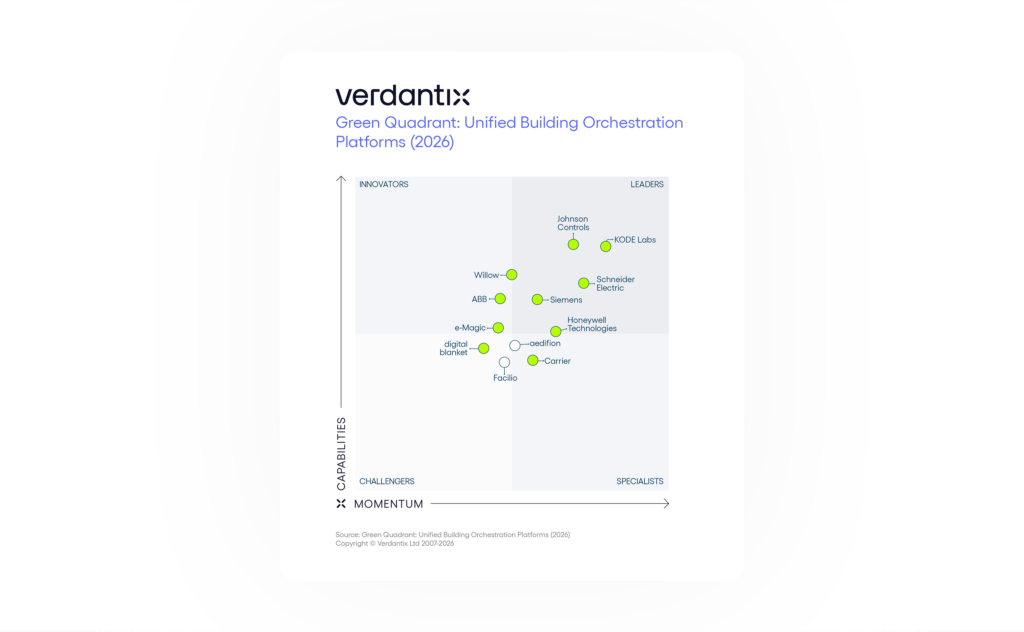
Independent research recognizes KODE OS as the building operating system connecting fragmented systems, data and workflows across complex real estate…
Read more
September was about closing the gap between seeing and acting. Operational teams aren’t short on signals. Faults surface in FDD.…
Read more