On this page
Subscribe to receive the latest blog posts to your inbox every week.
By subscribing you agree to with our Privacy Policy.
Verdantix has named KODE Labs a Leader in its Green Quadrant: Unified Building Orchestration Platforms (2026). More important than the recognition itself is what the category says about where building operations are going next.
Unified building orchestration brings connected systems, shared data context and operational workflows together so teams can coordinate actions across buildings and portfolios. Integration allows systems to exchange information; orchestration uses that information to support an operational outcome and verify the result.
For portfolio teams, this creates a foundation for applying consistent workflows across different buildings and giving AI the operational context it needs.
For years, the smart building industry has talked about connectivity.
Connect the BMS. Connect the meters. Then, connect lighting, access control, occupancy, utilities, maintenance systems and every other source of operational data.
That work mattered. But connecting systems was never the end goal.
A building can have thousands of connected devices and still require operators to move between different interfaces, interpret conflicting information, manually coordinate teams and decide what should happen next.
A portfolio can have more data than ever before and still struggle to answer a simple question:
What should we do about it?
That is the shift happening across building operations today.
The market is moving beyond collecting information and presenting recommendations toward platforms capable of understanding context, coordinating workflows and helping operators take action across systems and portfolios.
Verdantix now has a name for that category: Unified Building Orchestration Platforms.
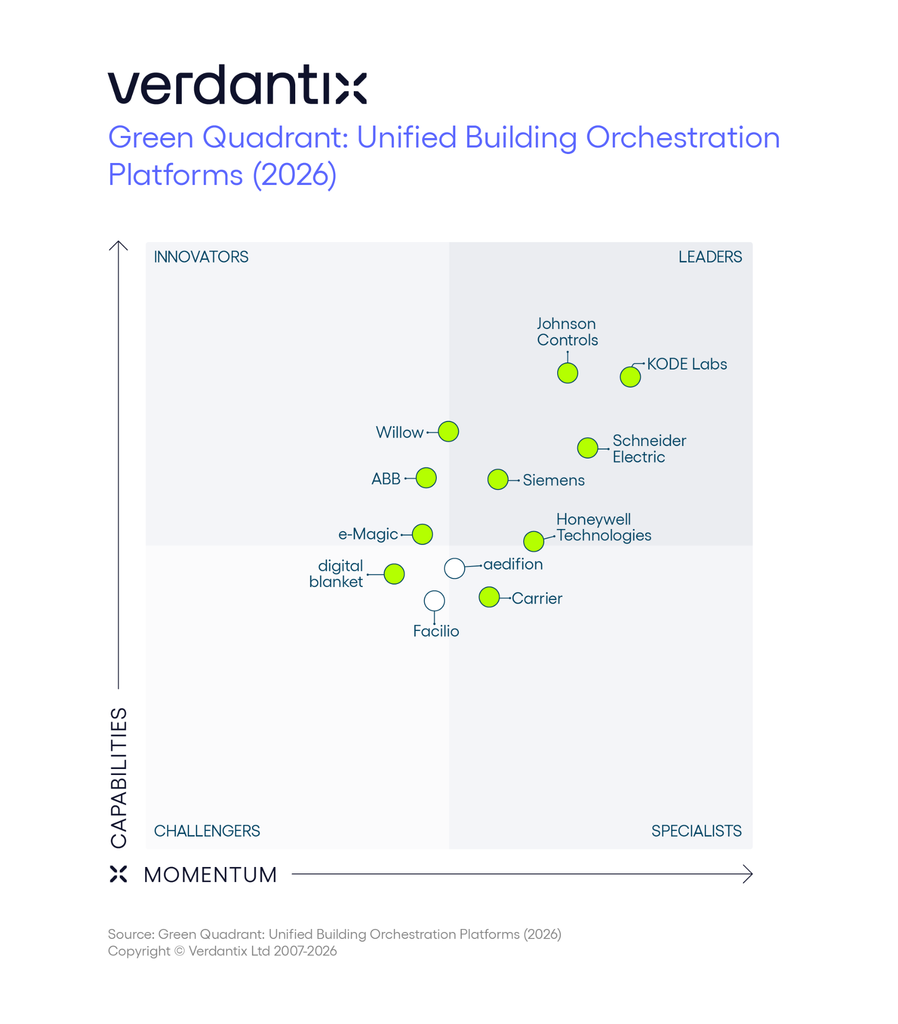
And in its new Green Quadrant: Unified Building Orchestration Platforms (2026), Verdantix has named KODE Labs aLeader.
We are incredibly proud of that recognition.
But for us, there is something even more significant about this research.
The category itself validates the problem we have been building KODE OS to solve from the beginning.
Walk into almost any large commercial building and you will find plenty of technology.
Building management systems. Lighting controls. Access control. Elevators. Energy meters. Indoor air quality sensors. Work order systems. Utility platforms. Tenant applications. IoT devices.
Walk across an entire real estate portfolio and the complexity multiplies.
Different generations of equipment. Different manufacturers and different protocols. It continues with different integrators. Different naming conventions. Different applications.
All individually capable. Very rarely designed to operate together.
The result is that the physical world has accumulated enormous amounts of technology without developing a common operational layer between it all.
Owners and operators are left managing buildings as collections of systems rather than operating their portfolios as coordinated environments.
This becomes particularly problematic as portfolios scale. A workflow that is manageable across one building becomes harder to coordinate consistently. across 10, 50 or 500.
And adding another application doesn’t necessarily solve it.
Sometimes it simply adds another place to log in.
The first generation of smart building platforms focused heavily on bringing information together. That created tremendous value.
For the first time, operators could aggregate information from multiple systems, visualize performance, identify faults and analyze what was happening across their buildings.
But visibility alone does not run a building.
Knowing that a piece of equipment is operating incorrectly is valuable. Understanding why is better. Automatically creating the right workflow to resolve it is better again. And verifying afterwards that the equipment is actually operating correctly? That closes the loop.
That’s the distinction between system integration and unified building orchestration.
Integration asks:
Can these systems exchange information?
Orchestration asks:
Can they work together toward an outcome?
That distinction becomes increasingly important as building portfolios become more complex and operating teams are expected to do more with fewer resources.
Verdantix’s 2026 assessment reflects that change. The research evaluates a market moving from insight and recommendation toward orchestration and control, benchmarking 12 vendors through a 71-point questionnaire, live demonstrations and buyer interviews.
For us, that evolution feels very familiar. Because it describes the architecture KODE OS has been built around all along.
There is a temptation in software to solve fragmentation by replacing everything underneath it.
We took a different approach.
The reality is that owners have already invested millions, sometimes hundreds of millions, of dollars in building infrastructure. Those systems are not disappearing. And they don’t need to.
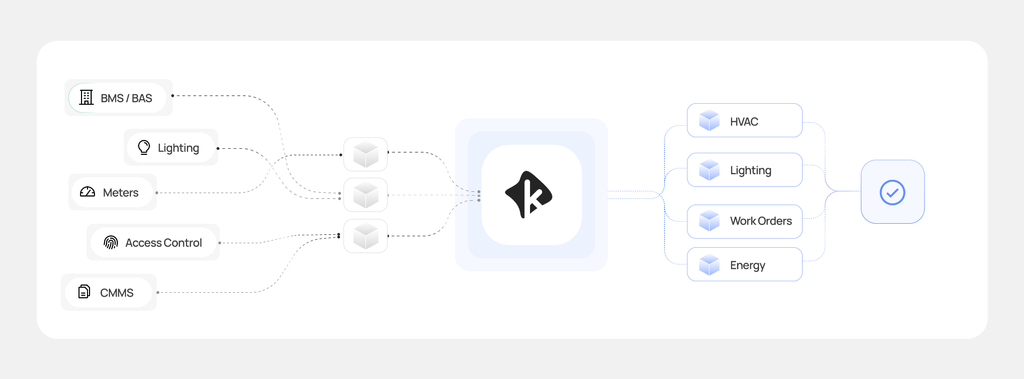
KODE OS is designed to sit above the existing environment and create a common operating layer across it. Our approach to unified building orchestration starts with four things.
A portfolio cannot operate as one environment if its systems cannot communicate.
KODE builds and maintains more than 250 connectors (APIs) across building technologies and controls vendors. The platform does not require owners to standardize their entire portfolio around one manufacturer or install a proprietary KODE gateway in every building.
That distinction matters. Real estate portfolios are heterogeneous by nature.
A platform designed for the built world has to embrace that reality rather than pretend it doesn’t exist.
Connecting data isn’t enough if every system still describes the physical world differently.
A temperature reading needs context.
What building is it in?
Then, what floor?
What space?
Which piece of equipment generated it?
What systems depend on that equipment?
What does normal operation look like?
This is where the ontology becomes critical.
KODE OS creates a common data model across systems and applications so information from the physical world can be understood through its relationships, rather than treated as disconnected points in a database. That common context is what turns building data into something operationally useful. And crucially, it is what makes building data usable by AI.
Once systems share context, workflows no longer have to stop at application boundaries.
A fault detected in one system can inform a workflow in another. A schedule can be coordinated across multiple sites. Operational changes can move across different controls environments.
Data from energy, equipment, occupancy and maintenance systems can contribute to the same decision. Instead of asking operators to connect the dots manually, the platform begins coordinating the dots for them.
This is where buildings start moving beyond dashboards. And toward operations.
Perhaps the most overlooked part of automation is what happens after an action has been taken.
Closing a work order does not necessarily mean a problem has been fixed. Someone may have visited the equipment.
A component may have been replaced.
A ticket may have changed status.
But is the equipment now operating correctly?
KODE’s Functional Testing Tool can re-test equipment sequences after corrective work, allowing teams to validate the actual operational result rather than relying only on workflow completion.
Verdantix identified this closed-loop capability as one of KODE OS’s strengths in its assessment.
That concept of verifying the outcome, not just the action, becomes increasingly important as more operational decisions become automated.
Every industry is racing toward AI. Building operations are no exception.
AI agents, predictive optimization and increasingly autonomous capabilities are beginning to change how facilities teams interact with their portfolios. But there is an uncomfortable reality underneath all of it.
AI cannot make fragmented infrastructure disappear.
In fact, the more autonomy we give software, the more important the underlying operational model becomes.
An AI agent needs more than a stream of sensor values. It needs to understand what those values represent. It needs relationships between equipment, spaces and systems. Additionally, it needs permissions. It needs operational context. It needs to understand where actions can safely be taken. And it needs mechanisms for humans to maintain oversight where appropriate.
This is why we believe the race toward AI in the built world is ultimately a race toward better infrastructure underneath it. The intelligence may become more sophisticated. But intelligence without context cannot reliably operate the physical world.
AI doesn’t eliminate the need for an ontology. It makes one essential.
There is another important part of the orchestration conversation that can sometimes get lost.
Scale.
A great piece of building software should obviously improve the operation of an individual building. But the larger opportunity is to change the way organizations operate entire portfolios.
Instead of every building behaving like its own technology project, a common operating layer allows standards, workflows, analytics and operational strategies to move across the estate.
A fault rule developed once can be deployed broadly. A schedule change can be coordinated across sites.
An operating standard can be measured consistently. Portfolio teams gain visibility without removing local control. And knowledge stops being trapped inside individual buildings.
That idea is central to KODE OS: manage the portfolio as an estate, not simply as hundreds of individual buildings.
It is also why vendor neutrality matters so much. Enterprise portfolios rarely have the luxury of uniform infrastructure. The platform has to work with the physical world as it exists.
Being named a Leader in the Verdantix Green Quadrant: Unified Building Orchestration Platforms (2026) is extremely meaningful to everyone at KODE Labs.
Independent validation matters. Verdantix assessed 12 vendors in the study, combining a detailed questionnaire, product demonstrations and interviews with buyers.
We are proud of where KODE OS was positioned.
But we are just as excited about what this category represents. Because the conversation around smart buildings is changing.
From systems to outcomes.
From integration to orchestration.
Visibility to action.
From isolated buildings to coordinated portfolios.
From software that tells people what happened to infrastructure that helps people, and increasingly AI, determine what should happen next.
That is the future we have been working toward since KODE was founded.
And we’re still at the beginning.
Read the Verdantix Green Quadrant: Unified Building Orchestration Platforms (2026) research to learn more about the market and KODE Labs’ position as a Leader.
Unified building orchestration uses connected systems, shared data context and coordinated workflows to support operational outcomes. It brings information and actions together so teams can identify an issue, manage the response and verify the result across buildings and portfolios.
Integration allows systems to exchange information. Orchestration uses that information to coordinate an operational process, such as connecting an equipment fault to a maintenance workflow and checking performance after corrective work.
A Unified Building Orchestration Platform provides a common environment for connecting building systems, organizing their data and coordinating operational workflows. It helps teams manage relationships between equipment, spaces and applications across a building or portfolio.
No. Unified building orchestration can work alongside an existing building management system. The BMS continues to perform its local control functions, while the orchestration layer connects relevant information and workflows across systems. Available capabilities depend on the interfaces, integrations and permissions in place.
An ontology describes the relationships between building assets, spaces, systems and data points. It gives readings and events operational context, helping teams understand what is affected and interpret information consistently across different systems.
Teams can compare post-repair performance with defined operating criteria and, where appropriate, run functional tests. This provides evidence of whether the equipment is working as expected and whether further investigation is needed.
Unified building orchestration brings together the data, relationships and workflows that give AI operational context. When AI supports actions, defined permissions, human oversight and outcome verification help teams govern how those actions are carried out. Unified building orchestration brings together the data, relationships and workflows that give AI operational context. When AI supports actions, defined permissions, human oversight and outcome verification help teams govern how those actions are carried out.
News, insights and resources from the world of smart building management.
By clicking "Sign Up" you're confirming that you agree with our Terms and Conditions.
AI is quickly becoming part of the building technology conversation, but AI-ready operations require more than adding a new interface…
Read more
Originally published on Leadership Today To redesign work for AI, leaders have to look beyond adding new technology to existing jobs…
Read more

For commercial real estate owners, utility costs are easy to think of as a monthly expense to reconcile, report and…
Read more