By Tom Peters
On this page
Subscribe to receive the latest blog posts to your inbox every week.
By subscribing you agree to with our Privacy Policy.
A global facilities director walks into Monday’s standup and asks a simple question: How did the portfolio perform last week?
Three regional teams send three different answers. One reports in kWh, another in cost, the third in carbon. Two define uptime differently. The West team’s work order backlog is not visible to the East team at all. The number that finally goes to the executive committee is a best guess wrapped in a spreadsheet.
That is not a data problem. It is a standardization problem. And it is what every multi-site enterprise eventually hits somewhere between building 50 and building 200.
The first ten buildings always feel manageable. Local teams know their equipment, vendors are familiar, and reporting is informal but workable. Then the portfolio grows. New regions get added. Acquisitions bring in different BMS vendors. Each site quietly develops its own version of “how we operate.”
By building 100, there is no single operating model anymore, now there are dozens. Equipment is named differently from site to site. Alarm thresholds were tuned by whoever set them up years ago. One region escalates a chiller fault in 15 minutes, another in 4 hours. Energy reports come back in three different units. Vendor accountability is a series of one-off relationships, not a portfolio-wide standard. Alarm fatigue across facility teams compounds the problem because the alarms that matter get lost in the noise.
None of these is a technology failure. They are the result of every site optimizing locally without anything holding the portfolio together. Leaders end up with inconsistent KPIs, inconsistent response times, inconsistent training, and limited visibility into what is actually happening.
The executive team is making decisions on a portfolio that they cannot see clearly.
This is the real ceiling on scale. Not headcount. Not capital. The absence of a portfolio-level operating standard that travels with every building.
Operators in the field have seen platforms come and go. Dashboards that nobody opens. Pilots that never scaled. Tools that added another login without removing any of the old ones. When a corporate initiative shows up with the words smart building attached, skepticism is the rational response.
“If you talk to a building operator, every single one of them is going to be frustrated with the tools they have to use. They’re working through four or five different tools that aren’t linked and aren’t user-friendly, and they’ve built workarounds to basically do their job.” — Thomas Peters, KODE Labs
That skepticism is worth taking seriously, because most platforms do earn it. They add on top of the existing mess instead of consolidating it. They give executives a nicer view of the same fragmented operations and leave operators with one more screen to check.
A real operating layer does the opposite. It absorbs the systems operators already use, such as BMS, alarms, schedules, work orders, energy data, FDD, dashboards, and consolidates them into one place. Making the operator’s day easier on day one, not harder. And gives leadership a single source of truth that reconciles back to what the people in the building actually see.
| Criteria | Dashboard | Operating Layer (KODE OS) |
Best for |
|---|---|---|---|
| What it does | Visualizes data from other systems | Consolidates and writes back to systems | Acting, not just watching |
| Operator experience | Adds another login | Replaces 4–5 tools with one | Day-to-day work |
| Data model | Read-only views | Vendor-agnostic ontology applied at ingestion | Portfolio-wide reporting |
| Scale | Per-building deployment | Portfolio-wide standard with 200+ integrations | Enterprises with 50+ buildings |
| Effect on stack | Adds to it | Replaces or absorbs FDD, BI, commissioning, energy tools | Software consolidation |
A dashboard helps you look at your portfolio. An operating layer is how you run it.
Standardization at scale is not bureaucracy. It is what allows a portfolio to keep growing without losing visibility. Four standards do most of the work.
We see this most clearly in clients managing tens of millions of square feet across multiple countries. Before KODE OS, they were running fragmented systems with siloed data and one-off integrations that broke at scale. After standardizing on a single operating layer with a consistent ontology and a pre-built integration library, new buildings come online in weeks instead of months, and the data behind every report is structured the same way regardless of vendor or geography.
Standards are what turn a collection of buildings into a portfolio.
Before going further, it is worth being specific about what KODE OS is and is not, because smart building platform has been used to describe a lot of different things.
KODE OS is the operating layer that sits between the building systems already on the ground and the people who run the portfolio. BMS, meters, lighting, occupancy sensors, work order tools, access control, leak detection, EV charging, and anything else with an API, KODE OS connects to it, normalizes it, and gives operators one place to act on it. It is vendor-agnostic, cloud-delivered, and built to consolidate rather than coexist.
In practical terms, that architecture replaces several platforms most enterprise portfolios are running separately:
KODE OS writes back, not just reads. Most smart building platforms are viewing layers. They aggregate data into dashboards but cannot change a setpoint, override a schedule, or command a piece of equipment. KODE OS does. Building operators can act on what they see from the same interface, across any BMS vendor.
It is built as one architecture, not a stack of acquired tools. KODE OS follows a five-layer model where each layer feeds the next: Connect, Control, Understand, Detect, Act. Data flows in through the Foundation, gets commanded through Cloud BMS, gets enriched through Building BI, gets continuously monitored through the Findings engine, and gets resolved through Action. A fault detected in one layer already has access to the trending data, ontology, and work order system in the others. Context travels with the data instead of getting exported and re-imported between disconnected products.
Open, with 200+ integrations and real data ownership. Customers own their data. KODE OS exposes it through open APIs and supports a client-side data lake, which means the portfolio’s operational data can flow into existing enterprise analytics, AI initiatives, and partner applications without lock-in.
For the full breakdown of how KODE OS connects, controls, and operates across a portfolio, see How KODE OS Brings Command and Control to Smart Buildings.
Most enterprise smart building initiatives stall on the business case. KODE OS does not, because the return comes from distinct layers that compound on each other.
With software consolidation across the existing tech stack, the ROI shows up on day one.
Most enterprise portfolios already spend six or seven figures annually running an energy platform, an FDD platform, a BI tool, a commissioning tool, a maintenance system, all separately. KODE OS replaces or absorbs most of that stack. The practical consequence for the buyer, this means one contract instead of five, one data model instead of five, one user experience instead of five.
Cutting four to five enterprise SaaS contracts out of the stack typically pays for KODE OS before any energy or maintenance savings are counted. That is before a single kWh is saved or a single work order is closed faster.
On top of that, optimization gains show up within months.
KODE OS includes an Optimized Start-Stop algorithm that uses ML to control system start and stop times based on real building conditions. In one six-month deployment, it saved 75,000 runtime hours, hit setpoint within 15 minutes of occupancy start 90% of the time, and held an average comfort score of 98% at occupancy. That is the kind of result that does not happen by adding another dashboard, it happens when the operating layer can actually write back to equipment, not just read from it.
The full operational ROI builds from there and compounds over the year.
Across the client base, KODE OS typically delivers up to 20% in annual energy savings and up to 50% in maintenance and operations savings, with payback measured in months rather than years. Beyond consolidation and optimization, the return comes from five places:
For Enterprise Real Estate and Building Technology Leaders, the value of a portfolio standard is straightforward. One source of truth across the portfolio. Faster access to performance, energy, alarms, comfort, uptime, and work order status. Less reliance on manual spreadsheets and emailed PDFs.
It also changes governance. Vendor performance becomes measurable across regions. Operational changes, a new alarm threshold, an updated escalation path, a portfolio-wide schedule can be rolled out in days, not quarters. Buildings and teams can be benchmarked against each other on equal terms, which makes both capital decisions and operational coaching easier.
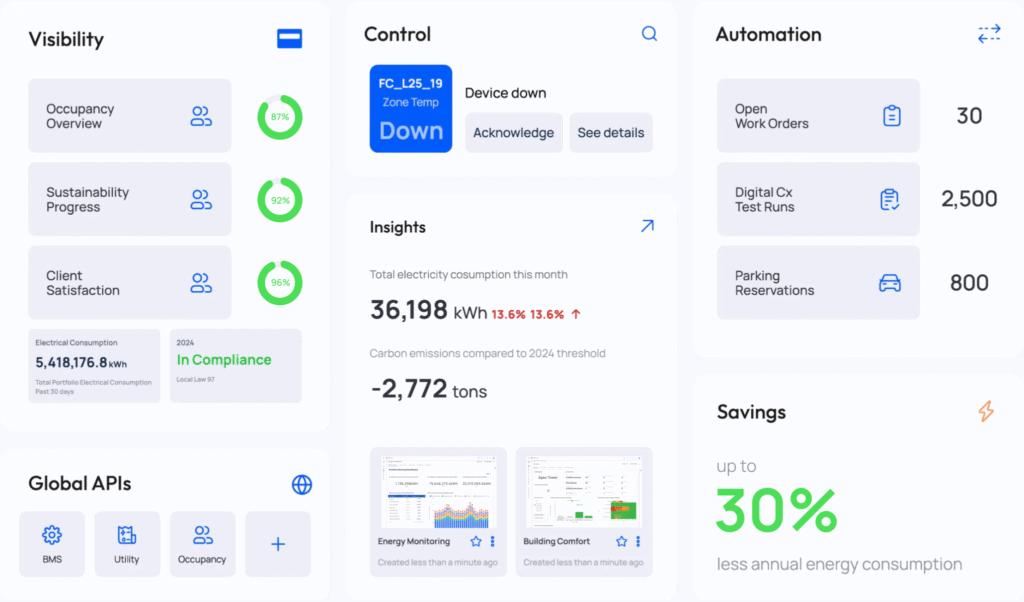
One enterprise KODE client wanted a portfolio overview their executives could open in the morning and immediately understand. We built a dashboard that gave them a quick snapshot across comfort, energy, setpoint compliance, and connectivity with one place to look and with the ability to drill into any region that needed attention. Before, that executive had to ask each region and assemble the answer. Now, the answer is already there.
The executive shift is from chasing information to acting on it and with a payback period that justifies the move on its own.
For enterprise buyers, none of this matters if the platform cannot meet IT and security requirements. KODE OS is SOC 2 Type 1 and Type 2 certified and aligned with NIST CSF, CIS Benchmarks, and OWASP. It supports federated identity with SSO and MFA, Zero Trust enforcement, just-in-time privileged access management, and full lifecycle access management. Penetration testing, vulnerability management, and continuous compliance monitoring are part of the standard delivery.
Data ownership is unambiguous: the client owns their data. KODE OS makes it available through open APIs and supports a client-side data lake architecture, which means the portfolio’s operational data can flow into existing enterprise analytics, AI initiatives, and partner apps without lock-in. This is what makes the OT-to-IT bridge real rather than rhetorical.
This is where most enterprise initiatives lose the plot. Buy-in at the top does not survive contact with the building unless the people actually running the building feel the difference, too.
The honest reality of building operator workflows in most portfolios is rough. Engineers move between four or five tools that do not talk to each other. They have built workarounds for software that nobody designed for how they actually work. New technology lands on them regularly, and they learn quickly that most of it does not stick.
KODE OS earns its place by removing friction. One interface for equipment, alarms, schedules, and work orders. Troubleshooting backed by trend data, FDD insights, and floor plan graphics instead of guesswork. Faults that arrive at the work order are pre-diagnosed, with likely causes and the device view one click away. Remote command and control through a native mobile app, so triage no longer requires driving to the site. Mass scheduling that turns a portfolio-wide change from a week of work into a few minutes. Preventive maintenance that actually gets done, with a record of what was done.
None of this replaces the operator’s expertise. It surfaces it. An operator who can show leadership exactly what happened, why, and what they did about it becomes a far more valuable part of the organization than one buried in disconnected tools.
The shift is from reactive responder to proactive building performance leader. Same person, same expertise, different reach.
One of the reasons most enterprise smart building initiatives stall is that implementation timelines are unpredictable. KODE OS deployments follow a structured four-phase model with concrete time windows: Design and Approval in 1–2 weeks, Network Connectivity and Integration in 3–5 weeks, Feature Activation in 2–4 weeks, and Client Onboarding as an ongoing motion. A single building can be live in roughly two months. Subsequent buildings move faster as the standard takes hold.
Support is structured around clear SLAs: under 30 minutes to first response on high-severity issues during business hours, with defined status updates and target resolution times around the clock. Clients can log issues 24/7/365 and reach the service team directly.
Most enterprises do not need more building technology. They already have too much. The question is whether all of it can operate under one standard and whether a portfolio of 50, 100, or 200 buildings can behave like one operation instead of fifty different ones.
KODE OS turns disconnected sites into a consistent operating model. It gives leaders the portfolio-wide visibility they have been trying to assemble manually, and it gives operators the tools to do their jobs at a higher level. The result is a portfolio that scales without losing control of itself and a team, top to bottom, that is finally working from the same picture.
See what your portfolio looks like under one standard.
Request a personalized walkthrough of KODE OS with your portfolio in mind.
A BMS controls equipment in one building. A smart building operating system like KODE OS sits above multiple BMS deployments and consolidates command and control, alarms, work orders, energy, FDD, and reporting into one portfolio-wide layer.
Dashboards visualize data from systems you already have. KODE OS consolidates those systems, writes back to equipment, and replaces stacks of separate FDD, BI, commissioning, and energy tools with one platform.
A single building typically goes live in about two months across four structured phases. Subsequent buildings move faster as the standard takes hold, and the platform ships with 200+ pre-built integrations.
KODE OS is built to consolidate the four or five tools operators already juggle into one interface, with a native mobile app, faster troubleshooting, and pre-diagnosed work orders. Operator adoption is the design goal.
KODE OS is SOC 2 Type 1 and Type 2 certified and aligned with NIST CSF, CIS Benchmarks, and OWASP. It supports SSO, MFA, Zero Trust enforcement, and just-in-time privileged access management.
The client owns their data. KODE OS exposes it through open APIs and supports a client-side data lake architecture, so portfolio data can flow into existing analytics, AI initiatives, and partner applications.
Clients typically see up to 20% in annual energy savings and up to 50% in maintenance and operations savings, with payback measured in months. Most also realize software consolidation savings by replacing separate FDD, BI, and commissioning tools.
It is vendor-agnostic and integrates with existing BMS deployments rather than replacing them. It typically replaces or absorbs standalone FDD platforms, BI tools, commissioning software, and energy management platforms.

Tom Peters
Director of Sales, KODE Labs
News, insights and resources from the world of smart building management.
By clicking "Sign Up" you're confirming that you agree with our Terms and Conditions.
Originally published on Leadership Today To redesign work for AI, leaders have to look beyond adding new technology to existing jobs…
Read more

For commercial real estate owners, utility costs are easy to think of as a monthly expense to reconcile, report and…
Read more
August was about making scale easier. As portfolios grow, operational complexity grows with them. More maintenance work needs to be…
Read more