On this page
Subscribe to receive the latest blog posts to your inbox every week.
By subscribing you agree to with our Privacy Policy.
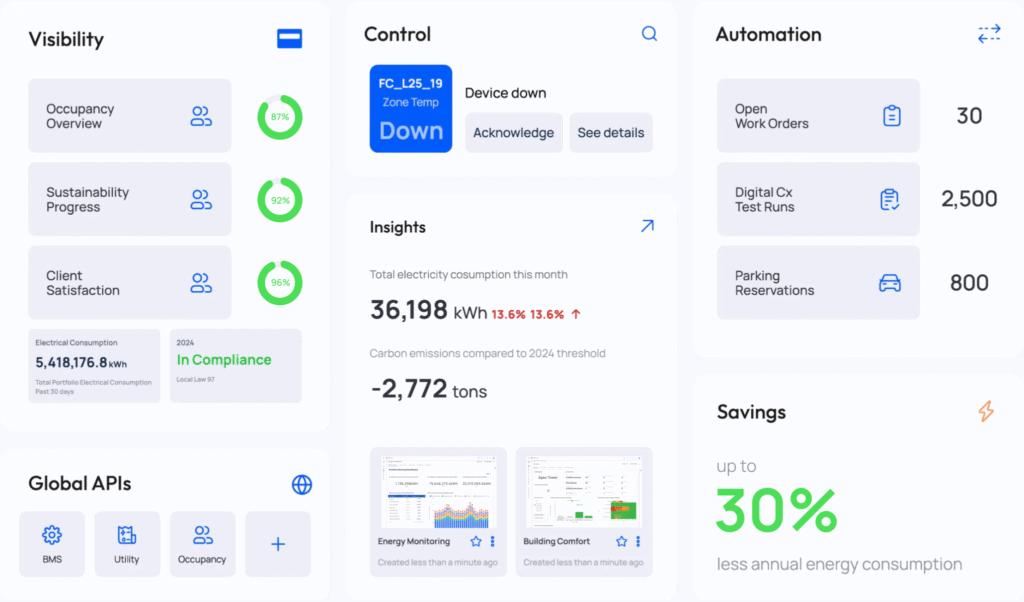
Corporate real estate teams now connect more systems and have access to more building data than ever. Dashboards can surface energy use, alarms, work orders, equipment performance, occupancy, and comfort conditions across entire portfolios.
Visibility alone does not improve operations.
Seeing that something happened is different from knowing why it happened, who is responsible for fixing it, whether the issue was actually resolved, and whether the same problem is happening somewhere else.
That is the next challenge for corporate building operations. The goal is no longer simply to make building data visible, but to use it to create accountability.
Corporate building operations need more than dashboards. Teams need an independent operating record that connects building data, service activity, and outcomes. That record helps them verify performance, compare sites, and make decisions from the same evidence.
At a glance:
Most large real estate portfolios are not short on data. A single building may use a building management system (BMS), utility meters, work order software, asset databases, occupancy platforms, environmental sensors, and vendor reporting tools.
Across dozens or hundreds of buildings, that creates an enormous amount of operational information.
The problem is that each system usually tells only part of the story. The BMS knows what the equipment did. The CMMS knows what work was recorded. The energy platform knows what was consumed. The FM provider knows what its teams responded to.
As a result, corporate real estate teams often have to connect those pieces after the fact. A dashboard may make each source easier to see, but it does not make the underlying systems work together.
The U.S. Department of Energy identifies the same challenge. Commercial building controls often involve several vendors, each using different hardware, software, protocols, and interfaces. According to the DOE, this lack of interoperability creates separate data silos and fragments building operations.
For portfolios operating across many sites, the challenge grows quickly.
The limits of visibility become obvious when something goes wrong, such as a floor suddenly becoming too warm.
The BMS flags the temperature. Someone opens a work order, a technician visits the site, and the service-level agreement (SLA) still shows a successful response. On paper, the process worked. However, that does not tell the full story.
Did the space return to the right temperature? Did the equipment recover? Has the same asset caused similar issues before? Did energy use increase while the problem continued?
Those questions separate activity from performance. Closing a work order is an activity; restoring the asset to normal operation is an outcome. Acknowledging an alarm is an activity; fixing the underlying cause is an outcome. Likewise, completing maintenance matters less if the same fault returns a week later.
Traditional reporting measures activity well. Corporate teams also need to know whether that activity changed building performance.
This distinction matters financially, too. The Department of Energy reports that high-performance controls can deliver about 30% annual HVAC energy savings in commercial buildings. Teams therefore need enough operational context to see where performance is slipping and whether their response actually worked.
For accountability to work, everyone involved needs access to the same version of what happened.
That means connecting the operational record across systems so teams can follow an issue from the moment it starts through the action taken and the result that follows. Instead of treating alarms, work orders, equipment trends, energy data, and comfort conditions as separate records, they become part of the same operational timeline.
This creates something more useful than another dashboard. It creates a shared operating record.
With that record, teams can see when a fault actually began, when it was detected, when a ticket was created, when someone responded, what action was taken, and how the equipment behaved afterward.
They no longer have to accept that a work order was successfully resolved simply because the ticket says “closed.” The reported activity can be checked against what actually happened in the building.
Most corporate real estate portfolios rely on several external partners to operate buildings. FM providers, controls vendors, energy specialists, maintenance contractors, and technology platforms each own or manage part of the operational data.
Each provider naturally sees the portfolio through the systems and processes it controls. That is not a problem by itself. The problem appears when one of those views becomes the only version used to judge performance.
Corporate real estate teams should be able to understand how their buildings are operating without depending entirely on a vendor to explain it.
Provider reporting still matters, but it should be one account of performance rather than the only account available to the client.
An independent operating layer gives corporate teams the ability to compare what is being reported with what actually happened in the building. That makes performance easier to verify regardless of which provider, system, or site is involved.
When both sides can work from the same evidence, performance conversations become easier to resolve and more focused on outcomes.
The value becomes even greater at portfolio scale.
A single building can look acceptable when viewed in isolation. Once similar buildings are compared, differences that were previously difficult to see become much clearer.
One site may consistently generate more reactive work than comparable locations. Another may use significantly more energy under similar operating conditions. A particular region may resolve faults faster, while another repeatedly sees the same issues return.
Those differences are difficult to manage when every site lives inside its own reporting environment. Once the data is normalized and viewed across the portfolio, isolated incidents begin to reveal patterns.
That gives corporate teams a better basis for deciding where attention is needed, where processes are working, and where operating standards should change.
It also changes the conversation with service providers. Performance reviews no longer need to revolve around reconciling different reports or debating whose numbers are correct. When both sides can see the same operational timeline, the discussion can focus on what happened, why it happened, and what should improve next.
The discussion moves away from reconciling reports and toward deciding what needs to improve.
The value of connected building operations is not simply that more information becomes visible. It is that information from different systems can begin to validate one another.
An alarm can be connected to a work order. A work order can be compared with equipment behavior. Equipment behavior can be viewed alongside energy consumption. Performance at one site can be benchmarked against similar sites. A recurring fault can be identified as a portfolio pattern instead of being treated as a series of unrelated incidents.
This is the operating layer KODE OS is designed to provide. It brings building systems, operational data, analytics, energy information, assets, and workflows into one environment, giving corporate real estate teams a clearer and more independent view of how their portfolio is actually performing.
Book a KODE OS Demo | Explore the Platform
Accountability means being able to verify what happened across buildings, systems, and service providers using shared operational data, rather than relying only on individual reports or dashboards.
Visibility can show that an alarm occurred, a work order was closed, or energy use changed. Accountability goes further by connecting those events so teams can understand whether the right action was taken and whether building performance actually improved.
Vendor-owned reporting is performance information generated primarily from systems controlled by a service provider or technology vendor. It can be useful, but it only reflects the part of operations that the provider can see.
By linking alarms, work orders, equipment behavior, energy use, occupancy, and other operational data, teams can see the full timeline of an issue and determine whether the response actually solved the problem.
Portfolio-level data makes it easier to compare similar buildings, identify underperforming sites, spot recurring issues, and understand where operational standards or service delivery may need to improve.
KODE OS connects building systems, operational data, analytics, energy information, assets, and workflows in one environment, giving corporate real estate teams a clearer and more consistent view of performance across the portfolio.
News, insights and resources from the world of smart building management.
By clicking "Sign Up" you're confirming that you agree with our Terms and Conditions.
Every day, Corporate Real Estate leaders make decisions that affect hundreds of people, multiple buildings, and millions in operational costs.…
Read more

Ask a corporate real estate leader how their facilities management provider is performing, and the answer usually traces back to…
Read more
A Corporate Facilities Management leader rarely spends the day inside a single building. Instead, they’re coordinating maintenance teams, responding to…
Read more