By KODE Team
On this page
Subscribe to receive the latest blog posts to your inbox every week.
By subscribing you agree to with our Privacy Policy.
Everyone wants AI in their buildings. Almost nobody asks the harder question first: what will the AI actually reason over? That question, not the AI itself, decides how smart buildings work, and whether yours ever gets there.
The conversation around smart buildings has moved beyond simple buzzwords. There was a time when having a modern HVAC setup or lighting you could schedule from a laptop was considered cutting-edge technology.
Today? That’s just barely scratching the surface.
The industry’s attention has shifted to AI, with promises of autonomous buildings, predictive maintenance, and intelligent operations. But AI doesn’t work in isolation. It depends on one thing above all else: access to complete, connected, and reliable data.
AI can make your building smarter, but only if your building has a model AI can reason over. Not more dashboards. Not more sensors. A complete, reconciled model of your portfolio, built by integrating, normalizing, contextualizing, and modeling the systems you already own.
What the numbers show:
Buildings generate tons of data, but without the right foundation, that data remains fragmented across systems.
Most buildings already have much of the necessary operational technology, but what they lack is a reliable model connecting it. The problem is that these systems do not communicate with each other. The good news is that you don’t need to actually rip out your old hardware and start over. Instead, you simply need to connect the components and create a unified data foundation that both AI systems and your operations team can use effectively.
Here’s a breakdown of how it all works.
The term smart building gets used frequently, but there’s still confusion about what it actually means. Is it installing more sensors? Adding AI? Replacing legacy equipment?
A smart building is not one with more gadgets, more sensors, or an app for the lights. Those existed a decade ago.
A smart building is one that has been modeled: every system, HVAC, lighting, metering, elevators, access, sensors, represented as one connected, trustworthy model of the building that both your team and your AI can operate and reason about. The distinction that matters in 2026 isn’t smart vs. dumb. It’s modeled vs. unmodeled.
In most unmodeled buildings, the building management system (BMS), IoT sensors, and utility data live in completely isolated silos; each tells its own story, and none of them agree. A modeled building reconciles all of it into one truth across systems and turns that truth into decisions mapped to the real objects that cause them.
The ultimate goal is simple: run the portfolio as one system, find the waste fragmentation hides, and make the building better for the people inside it.
AI needs complete, connected, and reliable data. Yet most buildings can’t provide it.
For example, ask an AI to identify energy waste when the chiller data lives in one system, the utility bills in another, and the work orders in a third. It will do what any intelligence does with fragmented inputs: guess. That’s why so many AI pilots stall. In many building AI deployments, the limiting factor is not the language model, but the absence of a complete, connected operational context. Without coherent information to reason with, the AI struggles to perform effectively.
This is where an ontology matters. An ontology is the structured vocabulary that tells software what everything in your building is and how it all relates. For instance, this point is a supply-air temperature, on this air handler, serving this floor, in this building. Without one, your data is a pile of cryptic point names. With one, your portfolio becomes an ontology AI can reason over: the substrate your AI and agents run on.
An ontology turns isolated information into a chain of meaning:
Temperature sensor → room → zone → VAV → air handler → chilled-water system → active fault → open work order
Each individual data point may already exist. The ontology tells the platform how those points fit together.
That is what allows software to move from “the room is hot” to “the room is hot because the air handler serving it is not delivering sufficiently cool air, and a related valve fault has been active since this morning.”
In short, AI is only as smart as the model beneath it.
A chief engineer opens an AI assistant and asks, “Why is the 12th floor hot again?”
The room-temperature trend is only one piece of the answer. To investigate properly, the AI needs to know which zone the room belongs to, which terminal unit serves it, which air handler serves that terminal unit, whether cooling is available, whether any commands are being overridden, and whether a related fault or work order already exists.
In most buildings, that information is scattered across different systems or exists only in the experience of the engineering team.
An AI assistant without that context can describe the temperature trend. It cannot reliably explain the building.
This gives readers a reason to continue before the article introduces ontology.
Every real smart building gets built in the same four steps. This is the framework behind the KODE OS data layer, and it works on the systems you already own.
1. Integrate. First, KODE OS connect every system in the building through its 250+ APIs and protocols like BACnet and Modbus. That includes the BMS, HVAC, lighting, metering, sensors, elevators, and access control. Legacy equipment included.
2. Normalize. Next, KODE OS translates every point from every vendor into one consistent naming and data standard. Machine-learning-assisted normalization does in days what manual re-tagging does in months. Systems that never spoke the same language now do.
3. Contextualize. Then, KODE OS maps the normalized data to an ontology aligned with open standards. Now the software knows what each point is, what equipment it belongs to, and what that equipment serves.
4. Model. Finally, KODE OS assembles it all into one live model of the whole portfolio: assets, schedules, work orders, energy, spaces, and people. This is the single, reconciled record your team operates and your AI reasons over.
In short, integration is step one, not the finish line. The finish line is a model.
A model changes the questions the platform can answer.
The difference is not simply better reporting. It is the ability to reason across the building and close the loop from detection to action.
A smart building is made up of several technologies working together. Some collect data, others connect systems, and others help operators monitor, automate, and optimize building performance.
Every smart building starts with the operational systems already inside it. Take HVAC, lighting, elevators, and water systems as an example.
Traditionally, these systems operate independently. A smart building connects them, creating a single ecosystem instead of isolated technologies.
Many commercial buildings already have a Building Automation System (BAS).
BAS controls HVAC, lighting, and mechanical systems using set schedules and automated logic.
A standard BAS is fine for running the equipment in one building, but it essentially operates in a bubble. It can’t talk to your other properties, and it can’t share data across a whole portfolio.
You don’t need to rip it out, though. A model-first layer sits right on top of your existing BAS, with remote command and control across any vendor’s BMS, so you can manage the whole portfolio from one place.
A building’s visibility starts with its sensors. Instead of waiting for a tenant to complain or a machine to break, these devices continuously track everything happening across your property in real time.
The biggest roadblock to a smart building is that different systems don’t naturally speak the same language. Different building systems often use different communication protocols, which means they don’t always communicate with one another.
A smart building platform acts as a translator for all of these languages, making it easy to connect both older machinery and brand-new tech without replacing your existing infrastructure.
Even when systems use different protocols, they still need a way to communicate. Gateways and middleware connect systems that weren’t designed to work together.
They translate data from every system into one common format so your tech can finally talk to each other. Instead of wasting money on custom, messy integrations every time you buy a new piece of equipment, middleware creates a standardized data layer right out of the box.
As a results, it completely strips away the engineering complexity, making it plug-and-play whenever you want to add new tech down the road.
Once building data has been connected, it needs a place to live.
Cloud platforms collect, store, and organize data from across the building portfolio.
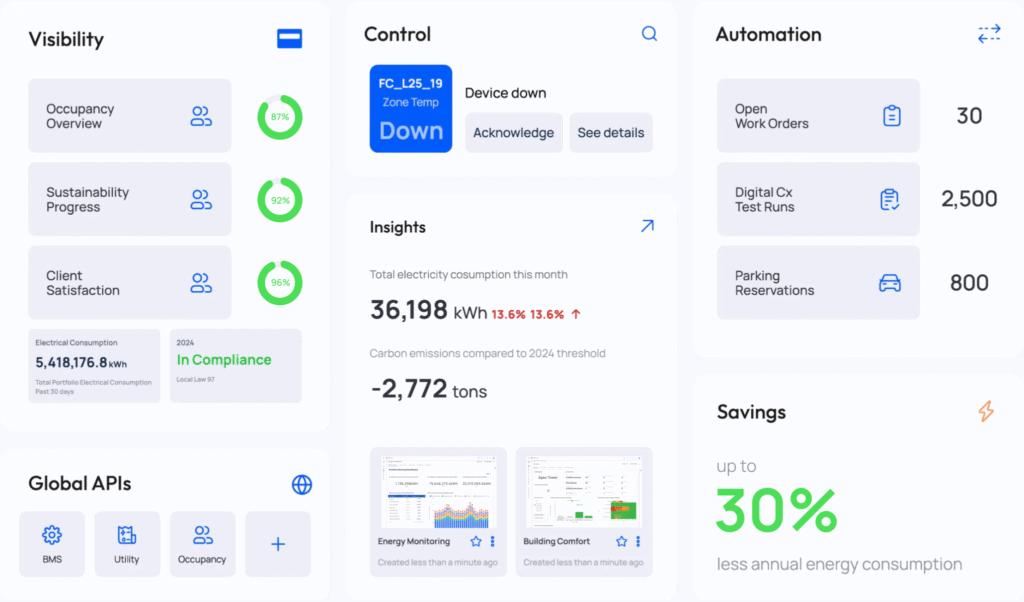
Now, instead of logging into separate systems for HVAC, lighting, security, and energy, you gain one centralized view of everything.
Raw data doesn’t fix a building. You have to actually understand what it’s telling you. Once building data is connected, analytics and AI help make sense of it.
Rather than waiting for something to go wrong, building teams can respond before things get out of hand. To see how that journey compounds, read how building data powers decisions from collection to long-term impact.
Smart building platforms get data from every piece of hardware you own and translate it into a unified framework, so that your systems can speak the same language.
Passive monitoring is dead. Seeing a problem on a dashboard doesn’t help if a technician still has to walk down to the basement to flip a switch. A true smart building requires “write-back” capability, meaning your software doesn’t just read data, but it talks back as well.
Layering AI over your operational data means you stop managing via the rearview mirror. The system can continuously evaluate equipment behavior, identify abnormal conditions, and direct the team toward the issues most likely to affect energy, comfort, or reliability.
Through this integrated energy intelligence, your daily workflows become inherently cost-effective. The system automatically tweaks production schedules and machinery uptime to kill waste, flattening peak energy demand without sacrificing output.
The old way of doing maintenance was reactive: wait for something to break, wait for a tenant to complain, and then fix it. Instead of waiting for an HVAC unit to die on a 90-degree day, digital, proactive maintenance monitors equipment health in real time to spot failures before they happen.
The moment a motor or compressor acts up, it automatically pushes a digital work order directly to your team, fixing the issue before it turns into an emergency.
Most offerings stop at screens that read data. That’s passive monitoring, and it doesn’t change outcomes. So here’s the comparison buyers should run:
| Criteria | Dashboard-first approach | Model-first approach KODE OS | Best for |
|---|---|---|---|
| What you get | Screens that display data | A model you can operate and reason about | Running a portfolio, not watching it |
| Data foundation | Renamed points | An ontology AI can reason over | Anything you want to build next |
| Truth | Overlapping tools that disagree | One Golden Record, one reconciled truth | Decisions you can defend |
| AI | A copilot bolted onto silos | Agents that reason over the portfolio model and act | AI that produces outcomes, not summaries |
| Action | Read-only; a technician still flips the switch | Write-back command and control | Closing the loop from detection to fix |
| Maintenance | Alarm noise | An incident engine that reasons over the model | Fixing failures before the 90-degree day |
In short, dashboards report the past, while a model operates the portfolio.
Adding a conversational interface to existing software is relatively easy. Building and continuously maintaining a trustworthy model of every point, asset, space, system, schedule, fault, and work order across a portfolio is not.
Without that model, AI can search, summarize, and produce plausible explanations. But it cannot consistently understand how the building is structured or how one operational condition affects another.
This is why the data foundation matters. The AI layer may be the part the user talks to, but the building model is what makes the answer specific to their portfolio.
Don’t think of making a building smart as buying more gadgets or piling on new software. It’s about getting the systems you already paid for to finally work together.
Right now, most properties run on separate, disconnected loops. But as energy costs rise and operations get more complex, managing your building in pieces just doesn’t work anymore.
The goal here is identical for a single flagship tower or a 50-property portfolio. You have to stop managing your building systems in isolation. Before you can worry about AI, you have to get your data connected first.
Right now, your team is drowning in “dashboard fatigue”. Toggling between five different clunky apps just to check the HVAC, adjust the lights, pull an energy report, or grant access to a floor drains your time.
KODE OS ends that headache. By forcing these isolated systems to speak the same language, it pulls everything into one model of the whole portfolio. You stop wasting hours chasing data across different vendors and finally get the unified control center you actually need to run an intelligent portfolio.
That means no more guessing games.
For owners and CIOs, that model is infrastructure you own your data through, neutral and standards-based, with payback typically inside 12 months.
That model wasn’t built overnight. KODE has spent nearly a decade building the normalized data layer, the ontology, that maps every integration into one standardized model of the portfolio. That is the differentiator. It gives AI full context to reason across every domain at once: assets, energy, maintenance, and spaces.
AI is already functional within the platform. Today it suggests asset and point modeling at deployment, generates root cause suggestions for faults, and recommends functional tests. As the platform demonstrates reliable recommendations, teams can progressively authorize more actions—from investigation and prioritization to supervised or automated control. Each step is possible because there is one model to reason over, with AI-driven portfolio operations running on top.
Smart buildings are a collection of connected technologies. KODE OS is the intelligence infrastructure that brings them to life.
The future of real estate is smart. Is your building ready?
A smart building uses connected technologies, data, and automation to improve how it operates. Rather than relying on isolated systems, a smart building brings together data from HVAC, lighting, security, energy, and other building systems in one place.
Smart buildings work in four steps: integrate every system, normalize the data into one standard, contextualize it with an ontology, and model the whole portfolio. Teams and AI then operate from that single model rather than from disconnected tools.
Yes. However, it can only happen if your building has the right data foundation. AI is only as effective as the data it receives. If information is trapped in disconnected systems, AI can’t see the full picture.
An ontology is the structured vocabulary that defines what every point, asset, and space in a building is and how they relate. It turns raw data into something software and AI agents can reason over, so you can build new capabilities on top without re-integrating anything.
Yes. Most existing buildings can be modernized without replacing all of their equipment. With the right integration strategy, legacy systems can often be connected to modern platforms.
No. KODE OS acts as a software layer that sits on top of what you already have. It doesn’t matter if your hardware is from five different vendors or is a decade old. The software connects to your existing systems, translates their data into one language, and gives you a single control center.
Smart buildings help organizations reduce energy consumption, improve operational efficiency, enhance occupant comfort, extend equipment life, and make better decisions using real-time data.
KODE OS connects building systems, normalizes operational data, and provides a unified platform for monitoring, automating, and optimizing building performance.

KODE Team
News, insights and resources from the world of smart building management.
By clicking "Sign Up" you're confirming that you agree with our Terms and Conditions.
Verdantix has named KODE Labs a Leader in its Green Quadrant: Unified Building Orchestration Platforms (2026). More important than the…
Read more
AI is quickly becoming part of the building technology conversation, but AI-ready operations require more than adding a new interface…
Read more
Originally published on Leadership Today To redesign work for AI, leaders have to look beyond adding new technology to existing jobs…
Read more